
Jade is not a standard birthstone in the modern American list, which surprises buyers who expect one month to own it.
Chinese practice works differently, assigning a zodiac animal rather than a month, and carving that animal in jade.
Both systems are in use today, and mixing them produces the confusion this page sorts out.
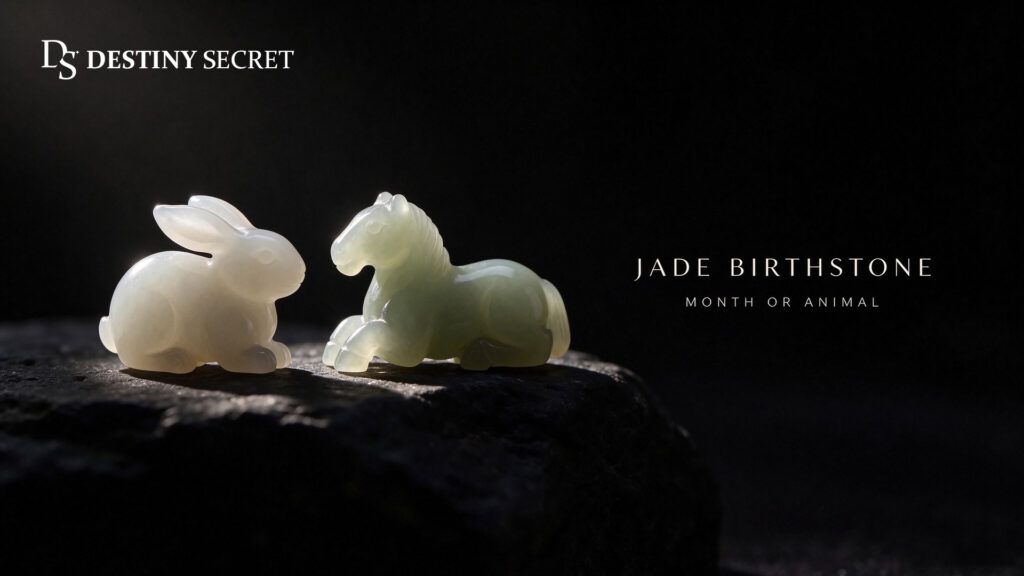
Table of Contents
- Is Jade a Birthstone?
- Where Jade Sits in Western Lists
- Zodiac Animals Instead of Months
- The Twelve Animals and Their Readings
- The Birth-Year Practice
- Does the Animal Have to Match the Wearer?
- Month-Based Alternatives
- Anniversary and Milestone Gifts
- Colour and the Occasion
- Buying a Zodiac or Birthstone Piece
- When Three Systems Conflict
- A Practical Approach
- Frequently Asked Questions
Is Jade a Birthstone?
The short answer is that jade appears in some lists and not in others, and the lists themselves disagree.
The modern American birthstone list, standardised in the early twentieth century and revised since, does not include jade.
Several commercial and alternative lists assign it to March as a secondary stone, and zodiac lists often pair it with Pisces.
Jade also appears on the traditional anniversary list at thirty-five years.
Where a recipient grew up matters here. A buyer raised on the American list will expect a month, and a buyer raised in Chinese practice will expect an animal.
None of those assignments carries official weight, which matters when a seller presents one as a rule.
The stone behind the symbolism sits in What Is Jade.
Where Jade Sits in Western Lists
Three Western systems mention jade, and each does something different with it.
| System | Jade position | Status |
|---|---|---|
| Modern birthstone list | Not included | The standard most jewellers follow |
| Alternative month lists | March, secondary | Commercial rather than official |
| Zodiac stone lists | Pisces, sometimes Taurus | Astrological convention, no standard |
| Anniversary list | Thirty-fifth year | Traditional American gift list |
A buyer asking for a jade birthstone gift therefore needs to know which system the recipient follows.
Jewellers usually follow the modern list, so a request for a jade birthstone ring may get a puzzled answer even from a well-stocked counter.
Online sellers tend to be looser, and several present jade as March without noting the alternative status.
Otherwise the stone is right and the occasion is wrong.
Zodiac Animals Instead of Months
Chinese practice assigns an animal to each birth year, and the animal rather than the month determines the piece.
Twelve animals cycle through the years, and a carved pendant of the wearer animal is a long-standing gift.
The animal set runs rat, ox, tiger, rabbit, dragon, snake, horse, goat, monkey, rooster, dog and pig.
A person born in a dragon year wears a dragon, and the piece is chosen for identification rather than for symbolism in the abstract.
The carving vocabulary behind each animal sits in Jade Motifs.
The Twelve Animals and Their Readings
Each animal carries a conventional character, and carvers follow those readings.
| Animal | Conventional reading | Common form |
|---|---|---|
| Rat | Resourcefulness | Small seated figure |
| Ox | Steady labour | Standing with head lowered |
| Tiger | Courage | Crouched, mouth open |
| Rabbit | Gentleness | Seated with long ears |
| Dragon | Authority | Coiled with cloud |
| Snake | Adaptation | Coiled, head raised |
| Horse | Progress | Standing or galloping |
| Goat | Harmony | Horned, seated |
| Monkey | Cleverness | Holding a peach |
| Rooster | Alertness | Standing with tail raised |
| Dog | Loyalty | Seated, alert |
| Pig | Abundance | Rounded, seated |
The readings are conventions rather than personality claims, and the wearer is not being told what they are like.
The Birth-Year Practice
Two habits surround zodiac jade, and they are often confused with each other.
The first is wearing your own animal, which people do from childhood onward.
The second is the red-cord practice at the turn of a zodiac cycle, when the animal year returns and people wear red and jade for protection.
That return happens every twelve years, and the twelfth year is treated as an occasion rather than a hazard.
The protective claim belongs to tradition and has no controlled evidence behind it.
The red element is the constant in both habits. Cord, tassel or bead carries the colour, and the jade supplies the permanence.
A piece worn for years then passes to a younger family member, which is how most zodiac jade actually survives.
Does the Animal Have to Match the Wearer?
Practice varies, and three situations cover most purchases.
- Personal wear: the animal matches the birth year, and mismatch reads as a mistake.
- Gifts for children: the child animal, given at birth or at the first cycle turn.
- Gifts for adults: often a pair of animals, where one represents the recipient and one a partner or a parent.
The pair option is where most errors occur, since the two animals need to be recognisable as a set rather than as two separate pieces.
Carvers usually orient the two animals toward each other on a single piece, and a pendant holding one facing away reads as two loose figures.
Dragon and phoenix work as a pair for marriages, and the pairing rules sit in Jade Dragon and Phoenix.
Month-Based Alternatives
If a recipient expects a birthstone rather than an animal, four months offer a defensible jade claim.
March takes jade in alternative lists, usually alongside aquamarine rather than in place of it.
Pisces, covering late February to late March, takes jade in most zodiac stone lists.
May offers green as the seasonal colour, and green jade reads as spring even where no list assigns it.
Anyone else can treat jade as a stone without a month, which is the honest position and the easiest to explain.
Anniversary and Milestone Gifts
One Western list does give jade a fixed place, and it is not a birth month.
The traditional American anniversary list puts jade at thirty-five years.
That assignment makes jade a reasonable choice for a long marriage, particularly in bangle form.
Other milestones use jade informally, including graduations and retirements, without a fixed convention.
A gift with a stated reason outranks a gift with a guessed one, whichever list the giver follows.
The anniversary reading also suits a bangle better than a pendant, since a bangle is worn continuously and a pendant tends to be reserved for occasions.
Colour and the Occasion
Colour choices vary by recipient and by region rather than by any fixed rule.
Green suits most gifting, since it carries the heart association and the widest recognition.
Pale green with good transparency reads as youthful, and darker green with low transparency reads as formal.
White nephrite suits older recipients in Chinese practice, where fine white material ranks highest.
Lavender jadeite sells as a young person stone, and it is the variety most often dyed.
Colour families and their trade names sit in Jade Colours.
Buying a Zodiac or Birthstone Piece
Five checks apply to any occasion-driven purchase.
- Animal legible without a label.
- Correct animal, checked against the birth year rather than the birth month.
- Untreated stone, since dye obscures carving detail.
- A setting that lets the stone sit against skin.
- Motif named on the listing, so the gift carries a stated meaning.
The second check is the one that goes wrong. Birth years turn over in late January or early February in the lunar calendar, and a January birth can belong to the previous animal.
Anyone buying near that boundary should confirm the year rather than assume it.
When Three Systems Conflict
Three systems circulate at once, and they rarely agree.
| System | Assigns by | Best used for |
|---|---|---|
| Western birthstone | Month | Jewellery conventions and retail expectations |
| Zodiac animals | Year | Chinese practice and animal carvings |
| Chakra colours | Colour and centre | Colour-led practice rather than gifting |
A buyer who knows which system the recipient uses avoids the common mismatch of a Pisces stone given to a Rabbit year.
The chakra system is a third layer with its own logic, and Jade and the Chakras covers it separately.
A fourth system sits underneath all three: the Chinese reading that assigns meaning to the stone itself rather than to a month or an animal.
A Practical Approach
Four decisions settle most birthday purchases.
Ask which system the recipient follows, and accept that many follow none.
For a Chinese recipient, use the animal and confirm the lunar year boundary.
For a Western recipient, treat jade as a stone without a month and explain why it was chosen.
Then spend the remainder of the effort on the stone rather than on the symbolism.
The cultural history behind those conventions sits in Jade in Chinese Culture.
Our Jade Bracelets name species and treatment on each listing, so an occasion purchase rests on a verified stone.
The wider question of what the stone is understood to carry, beyond any birth convention, sits in Jade Meaning.
Frequently Asked Questions
What is the birthstone for jade?
Jade is not part of the modern American birthstone list. Alternative lists assign it to March, zodiac lists pair it with Pisces, and the anniversary list places it at thirty-five years.
Is jade a March birthstone?
In several alternative and commercial lists, yes, usually as a secondary stone to aquamarine. The official modern list does not include it.
What zodiac animal jade should I buy?
The animal of the recipient birth year, not the birth month. Confirm the lunar year boundary if the birthday falls in January or early February.
Does wearing your zodiac animal in jade bring luck?
The practice is a documented tradition, and the protective claim has no controlled evidence. The object carries meaning rather than measurable effect.
Birthstone and zodiac assignments reflect published lists and cultural convention rather than gemmological rule. Protective claims belong to tradition, not to demonstrated effect.
Browse the full Jade Collection at Destiny Secret.