
A jade bangle is a continuous ring slipped over the hand, and the profile of that ring decides how it feels.
Five forms dominate the market, and each solves a different problem of fit or display.
Choosing the profile first makes the stone decision far easier.
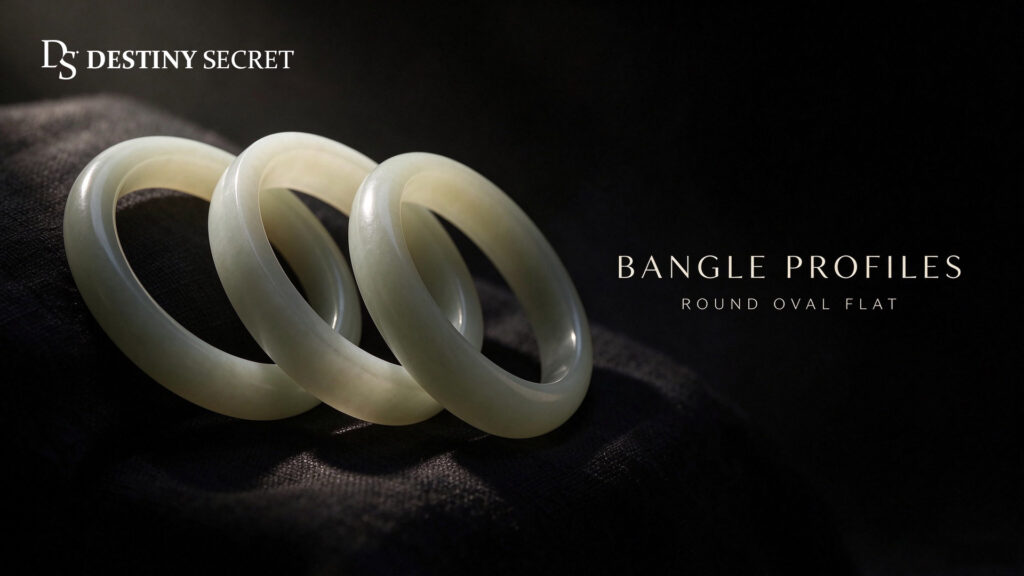
Table of Contents
- What Makes a Bangle
- The Four Classic Profiles
- Round Bar Against Flat Inner
- The Oval Bangle
- Carved, Twisted and Segmented Forms
- Band Width and Thickness
- Open and Hinged Bangles
- Square and Faceted Forms
- How Profile Changes Sizing
- Which Profile Suits Which Wrist
- Profile and Stone Species
- Checks Before Buying
- Where These Forms Come From
- Frequently Asked Questions
What Makes a Bangle
A bangle is a single rigid ring, and that rigidity is the whole point.
It has no clasp and no joint, so the wearer slides it over the knuckles, which is why the opening has to be larger than the wrist.
A beaded or linked bracelet works on a different principle, and the comparison sits in Jade Bracelet vs Bangle.
That distinction matters because sizing advice for one form does not transfer to the other.
The Four Classic Profiles
Four profiles come from traditional practice, and the rest are variations on them.
| Profile | Outer surface | Inner surface | Hand feel |
|---|---|---|---|
| Round bar | Rounded | Rounded | Classic, rotates freely |
| Flat inner | Rounded | Flat | Sits steady, common today |
| Oval | Rounded | Rounded or flat | Stays put, less rotation |
| Square | Flat faces | Flat | Distinctive look, edges matter |
Each has a trade-off, and none is better in every respect.
The names in Chinese trade usage map onto these four rather than onto separate ideas.
Round Bar Against Flat Inner
The difference between these two is the most consequential choice in the whole category.
A round bar contacts the wrist along a narrow line, so it rotates freely and rarely binds against bone.
A flat inner spreads contact across a wider surface, which keeps the ring from turning and makes a heavy piece feel lighter.
On a thin wrist, the flat inner can press on the ulna, and the wearer feels it after an hour.
On a fuller wrist, the flat inner usually wins for comfort.
Neither form is more traditional. The round bar is older, and the flat inner is a twentieth-century refinement.
The Oval Bangle
An oval ring is cut with one axis shorter than the other, so it passes over the hand when turned and then resists slipping.
That geometry solves the oldest problem in bangle wearing: a ring wide enough for the knuckles is loose on the wrist.
The oval answers it by making the narrow axis match the wrist and the wide axis match the hand.
It also means an oval bangle rotates less, which protects carved surfaces from rubbing.
Sizing an oval is harder, since the measurement has to be taken on both axes.
A buyer who knows only the round size can subtract roughly two millimetres from the long axis as a starting estimate, then confirm by trying it on.
Carved, Twisted and Segmented Forms
Three decorative profiles change the structure rather than only the surface.
| Form | Structure | Practical consequence |
|---|---|---|
| Carved | Relief cut into the band | Edges thin, so chips start there |
| Twisted | Two strands wound together | Deep grooves collect oil and dust |
| Bamboo joint | Banded segments | Segments act as weak points |
All three look better than they wear, which is not a reason to avoid them.
It is a reason to check the thin points before buying.
The carving craft behind these forms sits in Jade Carving.
Band Width and Thickness
Width and thickness are separate measurements, and both matter.
| Width range | Typical use | Trade-off |
|---|---|---|
| Under 8 mm | Slender wrists, younger wearers | Fragile at the edge |
| 8 to 12 mm | The mainstream range | Balanced for most wrists |
| Over 12 mm | Statement pieces, older wearers | Heavy, and harder to remove |
Thickness runs from about 6 mm to 10 mm, and a wide thin band cracks more easily than a narrow thick one.
A 14 mm band at 6 mm thick looks impressive and survives less than a 10 mm band at 8 mm thick.
Buyers rarely ask about thickness, and it predicts breakage better than width does.
Open and Hinged Bangles
Two forms solve fit by giving up the closed ring.
An open bangle has a gap, so the wearer needs no hand clearance and can size it like a bracelet.
A hinged bangle joins two halves at a metal clasp.
Both introduce a stress point, and a joint concentrates force in a way a continuous ring never does.
Jade and metal combinations that keep the stone intact sit in Jade and Gold.
Square and Faceted Forms
Square bangles remain a minority form, and the reason is practical rather than aesthetic.
Flat outer faces meet the hand at four edges, and each edge becomes a place where a chip can start.
Carvers compensate by keeping the band thicker at the corners, which makes the piece heavier overall.
The result looks architectural rather than organic, and that suits contemporary settings better than traditional ones.
Faceted variants multiply the edges, so buyers should treat the corner thickness as the deciding measurement.
How Profile Changes Sizing
Each profile needs a different measurement, and using one number for all of them causes returns.
Round and flat bangles are sized by internal diameter, taken across the widest opening.
Oval bangles need two figures, since the short axis governs whether the piece passes the hand.
A common error is ordering an oval at the diameter that fits a round ring, which produces a piece that will not go on.
Open bangles are sized like bracelets, by circumference, and that number means nothing for a closed ring.
Carved bangles add one more constraint: relief reduces the effective opening on the inner edge if the carving reaches inside.
Which Profile Suits Which Wrist
Four pairings cover most cases.
- Narrow wrist, first bangle: round bar at 8 to 10 mm, which is forgiving on bone.
- Wider wrist, daily wear: flat inner, which stays put and feels lighter.
- Active wearer: oval, which resists slipping during movement.
- Carved piece: oval or flat inner, both of which reduce rotation against the carving.
The fourth pairing is the one most often missed. A carved bangle on a round bar polishes its own relief away within a few years.
Anyone buying a first bangle should also consider how often the piece will come off, since frequent removal widens the opening over time in soft stones.
Profile and Stone Species
Species changes which profile holds up, and the reason is toughness rather than hardness.
Toughness describes resistance to impact, and it varies far more between the two species than hardness does.
Nephrite is interwoven and resists impact, so it carries a thin carved profile well.
Jadeite is granular, and a thin band with deep relief loses material exactly where stress concentrates.
Carvers therefore keep jadeite bangles heavier and cut shallower relief.
A very thin jadeite bangle with deep carving is a piece to inspect carefully rather than to trust.
The structural difference between the species sits in What Is Jade.
Checks Before Buying
Five checks catch most faults in a bangle.
- Uniform width around the full circumference, which a caliper confirms in seconds.
- No filled cracks, since filler shows as a line that changes under light.
- Clear tone when tapped with a fingernail, dull tone suggests an internal flaw.
- Edges not thin enough to catch a fingernail.
- Inner surface smooth where the wrist bone presses.
The third check is crude and useful. A bangle that rings cleanly has no major internal break.
A dull thud does not prove a flaw, but it justifies a closer look under a loupe along the inner edge.
Ask the seller to tap twice at opposite points, since a crack often shows on one side only.
Where These Forms Come From
The profiles carry regional histories rather than a single origin.
Round bar bangles appear in the earliest jade rings, some of which were ritual objects rather than jewellery.
The flat inner form became dominant in twentieth-century Chinese retail, since it uses stone efficiently and suits machine finishing.
Oval bangles are associated with southern Chinese practice, where they were made for women who worked with their hands.
Understanding that history helps explain why older pieces feel different on the wrist.
It also explains the vocabulary: most English terms are translations of Chinese trade names rather than gemmological categories.
Our Jade Bracelets state width, thickness and internal diameter for every bangle.
Beaded strands use a separate sizing system, covered in Jade Bead Sizes.
Men usually need a different width range, and Jade Styles for Men sets out those numbers.
Frequently Asked Questions
What are the main jade bangle types?
Four traditional profiles dominate: round bar, flat inner, oval and square. Carved, twisted and segmented forms are variations on those four.
Is round bar or flat inner better?
Flat inner sits steadier and feels lighter on a fuller wrist. Round bar rotates freely and suits a narrow wrist where a flat surface would press on bone.
Why wear an oval jade bangle?
An oval ring passes over the hand on its narrow axis and resists slipping on the wrist, so it needs less clearance and moves less during activity.
How thick should a jade bangle be?
Eight millimetres is a practical minimum for daily wear. Below that, cracking risk rises sharply, especially in jadeite with deep carving.
Fit and durability notes describe observed behaviour rather than a guarantee against breakage. Every bangle can crack if struck hard enough.
Browse the full Jade Collection at Destiny Secret.