
Jade colour comes from a handful of trace elements, and small changes in those elements produce the entire range.
The five families below cover almost everything on the market, from pale celadon to the black stone that turns green in transmitted light.
Colour is also the single biggest driver of price, which is why it attracts the most treatment.
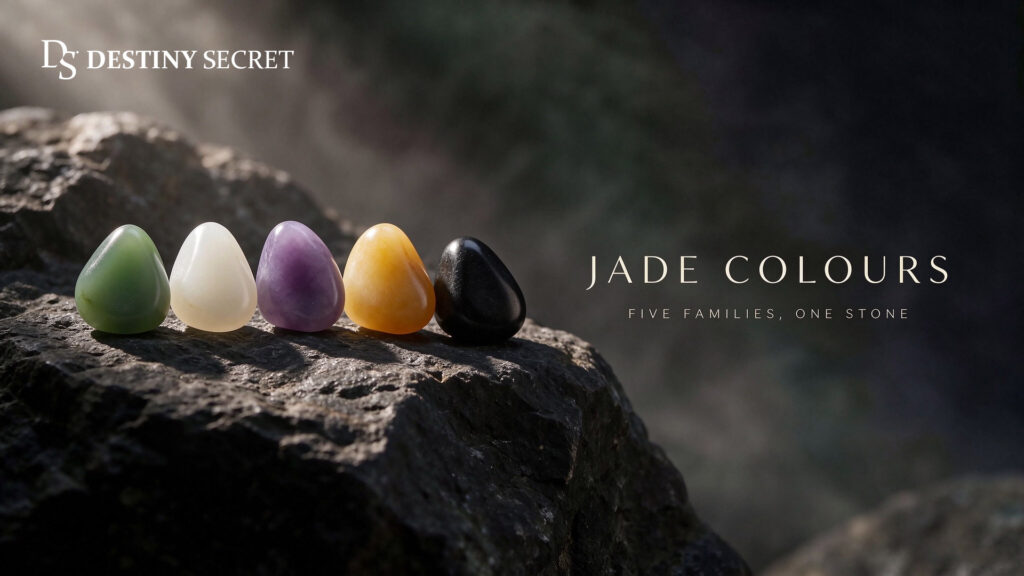
Table of Contents
- What Gives Jade Its Colour
- The Five Colour Families
- Green: Celadon to Imperial
- White and the Hetian Standard
- Lavender and Blue
- Yellow, Red and Brown
- Black Jade: Two Different Stones
- How Colour Is Graded
- Colour and Value
- Dyed Colour and How It Ages
- Colour and What Suits
- Buying by Colour Without Being Fooled
- Frequently Asked Questions
What Gives Jade Its Colour
Jadeite and nephrite colour for different reasons, and that difference explains why the two species rarely look alike.
In jadeite, chromium produces the vivid greens. Iron produces the duller yellow-greens and the browns. Manganese produces lavender and pink.
In nephrite, iron does almost all the work. Low iron gives the pale cream and near-white tones, higher iron gives the greens, and graphite produces black.
Because the colouring agents differ, no natural process turns nephrite emerald green. The chemistry does not allow it.
That is a useful fact at the counter. Vivid green stone is jadeite or it is something else, and our guide to What Is Jade covers the species in full.
The Five Colour Families
| Family | Typical tone | Species |
|---|---|---|
| Green | Celadon to imperial | Both, vivid green is jadeite |
| White | Cream to snow white | Mostly nephrite |
| Lavender | Pale lilac to violet | Jadeite |
| Yellow to red | Honey, amber, rust | Both, mostly jadeite |
| Black | Charcoal to ink | Both, different causes |
Almost every piece on the market falls into one of those five, and most fall into the first two.
The families overlap at the edges. A pale green can read as white in some light, and a brownish green can read as yellow.
That overlap is not a defect. It is the normal behaviour of a stone coloured by scattered trace elements rather than by a single pigment.
Green: Celadon to Imperial
Green is the colour most people mean when they say jade, and it covers the widest range.
Celadon is the pale, slightly grey-green of classical Chinese nephrite. It is soft, muted and rarely uniform, and it has been the default jade colour for centuries.
Apple green is brighter and more saturated, usually jadeite, and it reads as fresh rather than deep.
Imperial green is the top of the market: a saturated emerald tone with high transparency and no grey modifier. It is rare in large pieces, and priced accordingly.
Between those poles sit dozens of trade names. Most describe lightness or a secondary hue, and none of them is standardised.
The practical point is that green jadeite and green nephrite look different at the same saturation, because the nephrite is opaque and the jadeite is not.
Green also invites the oldest confusion in the trade, the one with emerald. Our guide to Jade versus Emerald separates them by mineral, hardness and price.
White and the Hetian Standard
White jade is almost always nephrite, and the reference is Hetian material from Xinjiang.
The trade calls the ideal mutton fat: a warm, slightly creamy white with a soft, oily lustre and enough translucency to look lit from within.
Ordinary white nephrite is chalkier and more opaque. It is still pleasant and much cheaper, and it is what most white jade jewellery actually uses.
White jadeite exists but is uncommon, and it tends to look glassy rather than warm.
The Chinese preference for white runs against the Western assumption that greener is better. Both are cultural, and neither is mineralogically superior.
Lavender and Blue
Lavender is a jadeite colour, produced by manganese, and it ranges from pale lilac to a deeper violet.
Fine lavender is even in tone and slightly translucent. Much of what reaches the market is patchy, with white or green zones mixed through.
Blue-green jadeite is rarer still. Trade names include blue water and, for the greyish variant, smoky blue.
Spring colour, the mix of lavender and green in one stone, commands a premium because both tones must appear naturally in the same block.
Lavender is also the family most often dyed, because the natural material is scarce and the colour is easy to imitate.
Yellow, Red and Brown
Iron produces the warm end of the palette, and the tones run from pale honey to a deep rust brown.
Yellow jade is usually jadeite, and the best of it is a clear, saturated honey tone rather than a muddy ochre.
Red and reddish-brown tones often come from surface weathering rather than from the body of the stone. Those are skin colours, and they sit on the outside.
A carved piece can include both skin and body, using the brown surface as part of the design. That is intentional, not a flaw.
In Chinese tradition yellow sits close to gold and to imperial status, though the market premium does not always follow the symbolism.
Black Jade: Two Different Stones
Black jade is two materials under one name, and they behave differently.
Nephrite takes its black from graphite inclusions. It is opaque, matte in the deeper tones, and often shows fine speckling under a loupe.
Ink jade, the jadeite form, appears black in reflected light and green in transmitted light. That behaviour is diagnostic and unmistakable.
The jadeite version is the more valuable of the two, because the green glow under a torch reveals a body that the surface hides.
A black stone that stays black under strong transmitted light is neither of these. It is usually serpentine, basalt or a dyed material.
How Colour Is Graded
| Dimension | What graders look at | Effect on price |
|---|---|---|
| Hue | Position on the green to blue to lavender range | Small shifts matter at the top |
| Saturation | Intensity without grey or brown modifier | The largest single factor |
| Evenness | Uniform tone across the surface | Even colour is rare and costly |
| Transparency | Depth of light penetration | Drives the imperial premium |
Four dimensions, and buyers usually weight them in that order, though saturation and evenness trade against each other.
A stone with strong colour and an uneven patch is worth less than one with slightly weaker colour spread evenly. The patch is what people notice.
Transparency matters most in jadeite, where it separates ordinary material from fine. In nephrite it matters less, because the stone is opaque by nature.
Photographs collapse three of the four dimensions. Hue survives, saturation is usually exaggerated, and evenness disappears.
Colour and Value
Price tracks colour more than any other property, and the curve is steep rather than linear.
At the top, a small increase in saturation or evenness can multiply the price. This is why two bangles from the same block can differ by a factor of five.
At the bottom, colour barely moves the price, because the material is common in every tone.
Size interacts with colour. A large piece in even, saturated colour is rare, and rarity is what the top of the market pays for.
For the numbers behind these tiers, our guide to What Jade Is Worth sets out how each grade is priced.
Dyed Colour and How It Ages
Dyed jade is the most common treatment in the colour market, and the trade grades it separately from natural colour.
Dye concentrates along cracks and grain boundaries. Under a loupe, the colour looks darker in the fissures than in the body, which natural colour never does.
Dyed stones often look too even, too vivid, or too well matched to their setting. Natural colour usually shows some drift across a large surface.
Over time, dye fades at the edges first and under sunlight fastest. Daily wear for a few years changes the look of any dyed piece.
Our guide on how to tell if jade is real covers the tests that separate natural from dyed colour.
Two references go deeper. The A, B and C Grade system explains what bleaching and dyeing actually do to the stone, and Jade Imitations lists the green stones sold in jade’s place.
Colour and What Suits
The stone’s colour and the wearer’s skin tone interact, and the effect is mostly about contrast.
Pale celadon and white suit cooler skin tones, where they read as soft rather than washed out. On warmer skin they can look yellow by comparison.
Saturated green works across most tones, because the contrast is strong enough to hold its own.
Lavender is the most forgiving of the pale families, and buyers who find green too traditional often choose it.
Black jade is the easiest to wear daily. It reads as neutral, it hides scratches better than pale stone, and it does not compete with clothing.
Colour choices also depend on the form. Width changes how colour reads. A wide bangle shows a uniform tone better, while a bead strand breaks colour into twenty small surfaces, which hides patchiness and rewards evenness.
Buying by Colour Without Being Fooled
Three habits cover most of the risk in colour buying.
- Ask for a daylight photograph outdoors, not a studio shot on white.
- Compare the stone to a known natural piece, ideally a small one you already own.
- Check the colour under a warm lamp and a cool lamp, since dye and natural colour drift differently.
Then ask what happens to the colour over time. A seller who says a dyed stone will not change is either misinformed or hoping you will not ask again.
The most useful question is the simplest: is this colour natural, and can you put that in writing?
Written answers protect you. Verbal ones protect the seller, and that asymmetry is the whole game.
Frequently Asked Questions
What is the rarest jade colour?
Fine imperial green jadeite and even lavender are the scarcest at retail. Imperial green requires saturated colour, high transparency and no grey modifier in a single piece, and those conditions rarely coincide. Even lavender is also uncommon, because most lavender material is patchy rather than uniform.
Is black jade real?
Yes, in two forms. Black nephrite gets its colour from graphite, and black jadeite appears black until light passes through it, when it turns green. A black stone that stays black under strong transmitted light is usually serpentine or a dyed material, not jade.
Can jade colour change over time?
Natural colour is stable in normal wear. Dyed colour fades, starting at the edges and moving fastest under sunlight. Polymer-filled stone can also yellow slightly with age. If a piece has changed noticeably in a year of wear, treatment is the likely reason.
Which jade colour is most valuable?
Saturated, even green jadeite with high transparency, usually described as imperial green. Value follows colour quality rather than colour family: a fine lavender can outrank a dull green. Evenness and saturation matter more than hue on their own.
Colour descriptions reflect trade usage rather than standardised measurement, and screens render colour differently. Natural stone varies from piece to piece, and photographs may not reflect true colour. Treatment affects both appearance and long-term stability.
Browse the full Jade Collection at Destiny Secret.