
The dragon and phoenix are the most politically loaded pair in Chinese decoration, and the most common pairing on jade sold today.
The dragon stands for authority and the phoenix for grace, and together they read as a complete marriage.
That pairing is why the motif sells as a wedding gift and why a mismatched piece fails the occasion.
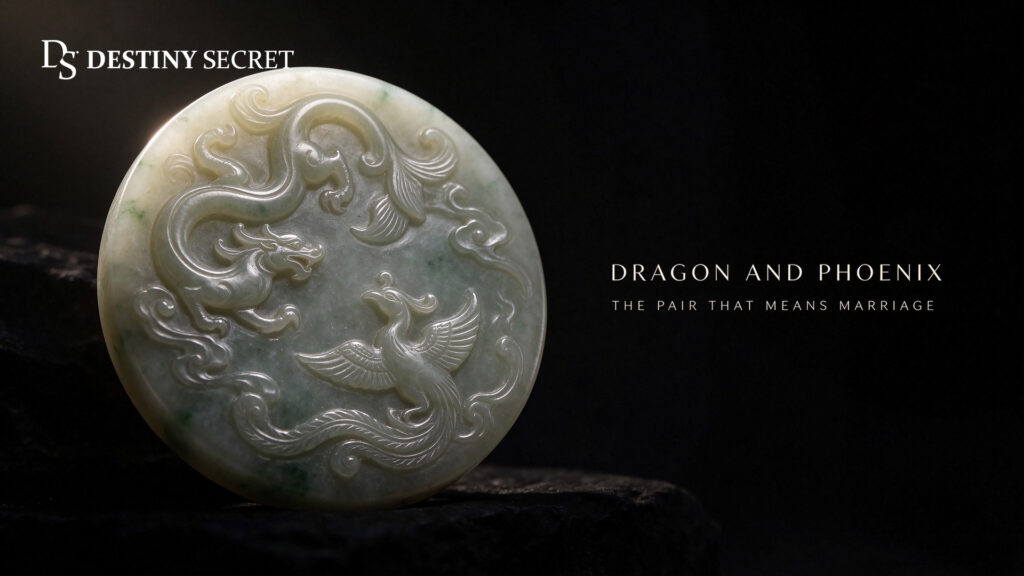
Table of Contents
- Why the Two Appear Together
- What the Dragon Means Alone
- What the Phoenix Means Alone
- How Each Creature Is Composed
- The Claw Count
- The Pearl and the Cloud
- Phoenix with Peony
- The Wedding Pair on Bangles
- Regional and Modern Variants
- Carving Quality and Stone Choice
- Checking a Pair Before Buying
- Buying as a Gift
- Frequently Asked Questions
Why the Two Appear Together
Dragon and phoenix began as separate symbols and merged into a pair over centuries.
The dragon carried imperial authority, and the phoenix carried the empress, so the pair described the court at its most formal.
Both creatures were also direction symbols, with the dragon assigned to the east and the phoenix to the south.
Popular use took the pair out of the palace and turned it into the standard wedding motif, where the meaning became balance between two people.
Both creatures appear on jade in every species, and What Is Jade separates the two stones that carry them.
What the Dragon Means Alone
A single dragon reads as power rather than partnership, and that changes the gift entirely.
It stands for authority, protection and the ability to control circumstances.
It also stands for scholarship in one specific reading, since the dragon appears in the phrase for success in examinations.
Buyers often choose a lone dragon for men, particularly for a first job or a promotion.
That choice works. The same piece given as a wedding gift does not, since a single creature answers a question the occasion did not ask.
Carvers sometimes add a pearl to soften the reading, and the result sits between power and play.
What the Phoenix Means Alone
The phoenix here is the fenghuang, a pair of birds in origin rather than a single fire bird.
It stands for grace, renewal and the arrival of good fortune, and it appears in phrases about a worthy marriage.
Icons of it show a long tail, a crest and the head turned back, which distinguishes it from a crane or a pheasant.
The single form reads as elegance rather than as partnership, which suits a gift for a woman or for a daughter.
Confusion with the European phoenix is common, since the fire and the rebirth carry into marketing copy without any basis in the Chinese form.
The two are unrelated. One is a paired bird of good omen, and the other rises from its own ashes in a Greek story that reached Chinese decoration only through translation.
How Each Creature Is Composed
Both have fixed compositions, and the details are what carvers reproduce.
| Element | Dragon | Phoenix |
|---|---|---|
| Head | Camel-shaped, jaw open | Crested, small beak |
| Body | Snake-like with scales | Bird body with varied plumes |
| Tail | Fish-like fins | Long trailing tail |
| Limbs | Eagle claws, tiger palms | Thin legs, slender feet |
| Extras | Horn, cloud, pearl | Peony or blossom branch |
A carver working from tradition reproduces those features, and a carver working from a photograph often does not.
That difference is visible at a glance once a buyer knows which parts to check.
The Claw Count
Claw count once signalled rank, and it explains a lot of the confusion in old pieces.
| Claws | Historical use | Modern reality |
|---|---|---|
| Five | Emperor, and imperial property | Rare, and claims are marketing |
| Four | Princes and senior nobles | Common on modern carvings |
| Three | Officials and popular use | The usual count in retail |
Strict rules on claws applied in the Qing period, and violations carried consequences.
Nothing enforces that today, so a seller describing five claws as imperially authorised is describing marketing rather than law.
The count still matters for one practical reason: a piece with four or three claws suits ordinary gifting, and a five-claw claim invites a provenance question.
Carvers also vary the count by accident. A four-claw dragon with one claw hidden inside the cloud is technically five, and no buyer can verify that at a glance.
The Pearl and the Cloud
Two supporting elements complete the dragon, and both affect legibility.
The pearl, sometimes a plain disc, sits ahead of the head, and the dragon chases rather than holds it.
Cloud forms, either the rolling kind or the stylised spiral, fill the background and frame the figure.
Cloud without a pearl reads as a scene, and pearl without cloud reads as a simple device.
Both are cheap to carve and easy to lose at small scale, which is why tiny pendants often drop them.
A pendant under two centimetres cannot hold a pearl, a cloud and a full body at once, so the carver chooses and the buyer should notice which element went missing.
Phoenix with Peony
Peony is the phoenix companion, and the combination carries a name that translates as prosperity and honour.
The pairing appears on bridal pieces, on boxes and on textiles far more than on jade.
On jade, the peony usually sits below the bird, since the flower supports the figure.
A phoenix without a branch looks unsupported rather than simple, which is a design flaw rather than a shortcut.
Peony also carries its own reading of wealth and honour, so the combination doubles rather than repeats.
The Wedding Pair on Bangles
The dragon and phoenix pair appears most often on two bangles given together, one carved with each creature.
Giving both to one person is a common practice in modern sets, and so is giving one each to a couple.
The pair on a single bangle carved end to end is the more traditional arrangement.
Bangles suit the motif because the band gives room for a full body, and the form itself appears in traditional wedding sets.
A set of two bangles usually pairs one carved dragon with one carved phoenix, and the pair is then worn on the same wrist or split between two people.
Bangle sizing and fitting matter more than the carving for wearability, and the differences between a bangle and a beaded bracelet sit in Jade Bracelet vs Bangle.
Regional and Modern Variants
Three variants appear often enough to recognise.
- The two creatures carved facing each other, which reads as dialogue and suits wedding pieces.
- Dragon above, phoenix below, which reads as hierarchy and suits formal gifts.
- A phoenix alone with a peony, which reads as prosperity and suits a gift for a household.
Modern retail adds a fourth: both creatures compressed onto a small pendant, where the composition rarely survives intact.
That compression is the most common reason a dragon-phoenix pendant looks wrong without being obviously fake.
Carving Quality and Stone Choice
The motif suits certain stones better than others, and carvers choose accordingly.
Pale green nephrite shows shallow relief clearly, since contrast comes from shadow rather than colour.
Saturated jadeite hides detail, so carvers cut deeper and simplify the composition.
Colour banding offers an advantage: a dark streak becomes the dragon, a pale area becomes cloud.
The full craft sequence, from block to finished piece, sits in Jade Carving.
Checking a Pair Before Buying
Five checks catch most problems in a carved pair.
- Both creatures present, with neither replaced by a qilin or a lion.
- Facing each other rather than looking away, unless the composition is deliberately hierarchical.
- Claw count consistent between the two pieces in a set.
- Relief deep enough to read at arm length.
- Stone untreated, since dye pools in the recesses and flattens the carving.
The second check matters most. A pair turned outward reads as two single pieces rather than as a couple.
Sellers rarely mention that, and it changes what the gift says more than the stone quality does.
The wider vocabulary, including the longevity and wealth groups, sits in Jade Motifs.
Buying as a Gift
Three practical notes apply to any dragon-phoenix purchase.
Match the pair to the occasion: a wedding wants both creatures, and a promotion wants the dragon alone.
Ask for the motif to be named in writing, so the gift carries a stated wish rather than an assumed one.
Check the size against the recipient. A bangle that does not fit becomes a drawer piece, whatever the carving says.
Birth-year conventions are a separate system from motif meanings, and Jade Birthstone explains how the two differ.
The cultural background for both creatures sits in Jade in Chinese Culture.
Our Jade Bracelets name any carved element on the listing, so a gift arrives with its meaning attached.
The broader reading of what the stone itself is understood to carry sits in Jade Meaning.
Frequently Asked Questions
What do the dragon and phoenix symbolize together?
A complete marriage, with the dragon as authority and the phoenix as grace. The pair also stands for balance between two people.
Is the dragon male and the phoenix female?
In the wedding reading, yes: dragon for the groom and phoenix for the bride. Historically both were imperial symbols, with the phoenix attached to the empress.
How many claws should a jade dragon have?
Three is the usual count on modern retail pieces, and four appears on better carvings. Five claws once marked imperial use, and today it signals a marketing claim.
Should a dragon and phoenix face each other?
Yes for a wedding pair, since facing each other reads as dialogue. A hierarchical composition places the dragon above, and that suits formal gifts instead.
Symbol meanings follow documented Chinese decorative tradition. Claims about luck or marital fortune describe convention rather than guaranteed outcome.
Browse the full Jade Collection at Destiny Secret.