
About
Destiny Secret makes handcrafted bracelets from natural stone. One small workshop, four pairs of hands, and short runs that we can still check one piece at a time. This page explains what we make, where the stone comes from, how we work, and what we will not do.
- 1. What We Make
- 2. Where the Stone Comes From
- 3. How We Work
- 4. What We Refuse
- 5. Why Stone, and Why the Name
- 6. What You Get, and How To Start
1. What We Make
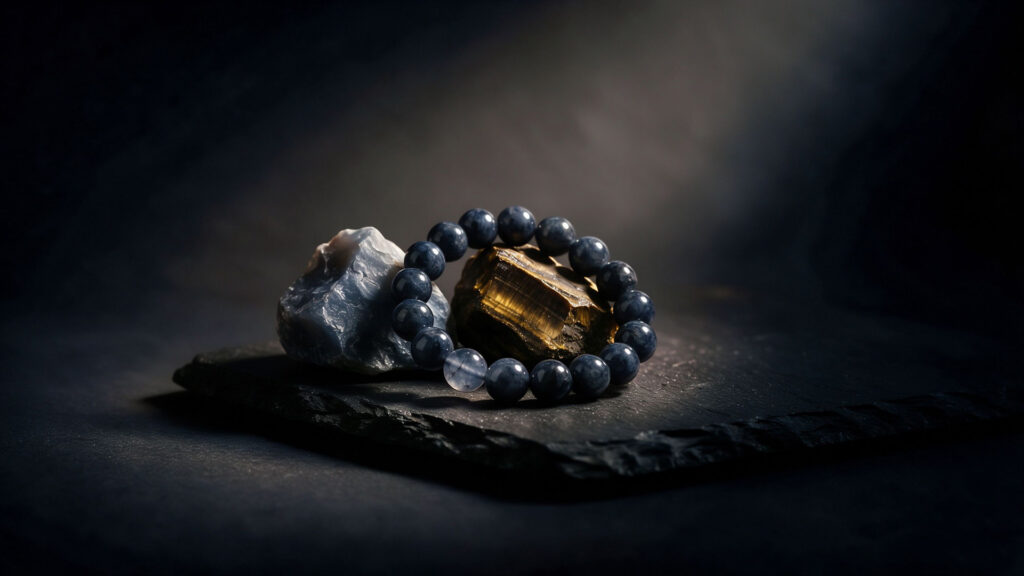
Every bracelet starts as rough stone and ends on a wrist. We work with agate, tiger’s eye, lapis, and jade. Each one is a single material, not a mix, and nothing about it is decorative first.
We make for people who want a piece that still looks like a stone. That means uneven colour, visible veining, and a surface that keeps the marks of the saw and the wheel. We do not plate, dye, or reconstitute. What you see is what the ground made.
2. Where the Stone Comes From
Stone is the largest cost in a bracelet, and therefore the easiest place to cut a corner. So we buy rough, not polished, from three suppliers we have used for years.
Agate comes from Brazil and Uruguay, where the banding runs dense and the colour holds. Tiger’s eye comes from South Africa. Lapis comes from a single lot out of Afghanistan that we inspect ourselves before it ships.
But jade asks a harder question. Buyers want to know two things first: is it real, and has anyone treated it. So we answer both with testing rather than adjectives. Every jade piece goes to a lab before it goes onto a string, and the report travels with the order. We do not bleach, we do not fill with polymer, and we never pass treated stone off as untreated.
Still, rarity is not a slogan here. Good rough arrives in small lots, and when a lot runs out we do not swap in something cheaper that looks close. So we wait, and the price reflects that wait.
3. How We Work
Four steps, in this order.
First, we read. One person sorts every rough piece by hand and sets aside anything with a crack that runs through the bead.
Then we cut and polish. No tumbling line, no batch finishing. Each bead gets shaped on a wheel until its edges sit right against the next one.
After that, we string. Silk cord, knotted by hand, cut to the wrist it is made for.
Last, we name an intention over the finished piece. Because that layer never appears on a card, a listing, or an invoice, we do not sell it as an upgrade.
4. What We Refuse
Then four refusals, each of them practical.
For one, we do not run a production line. A line would lower the cost per bracelet and the quality of every one of them.
We do not sell the second layer separately. Once intention becomes a paid extra, the piece stops being a piece and starts being a package.
We also do not promise outcomes. No bracelet changes a life on its own, and any brand that says so is selling you a sentence.
Finally, we refuse to print limited edition on work we can make again next month. If a lot is gone, we say so plainly.
5. Why Stone, and Why the Name
Destiny is the stone. Every piece arrives with a character nobody chose: its colour, its veining, and what it will never become. We do not correct that.
Secret is what we add afterwards, quietly and once. Together, then, the two halves make the offer. Destiny is what the stone brings. The secret is what we add.
The workshop behind all of this, however, has stayed in one family for four generations. That story sits on our Founder’s Journey page.
6. What You Get, and How To Start
Every order leaves the workshop finished, checked against the lab report where one applies, and sized to the measurement you send. In practice, care is simple: warm water, a soft cloth, and no harsh cleaners.
If you want a stone with colour in it, start on our Beaded Bracelets page. If you want jade, the Jade Bracelets page gathers every piece we currently test and hold.
Read the stone before you read the price. That is the whole method.