
Bead diameter and bead count are two different numbers, and buyers routinely confuse them.
Diameter sets the look, and count sets the fit, and only the pair together produces a strand that works.
This page gives both, with the arithmetic behind each.
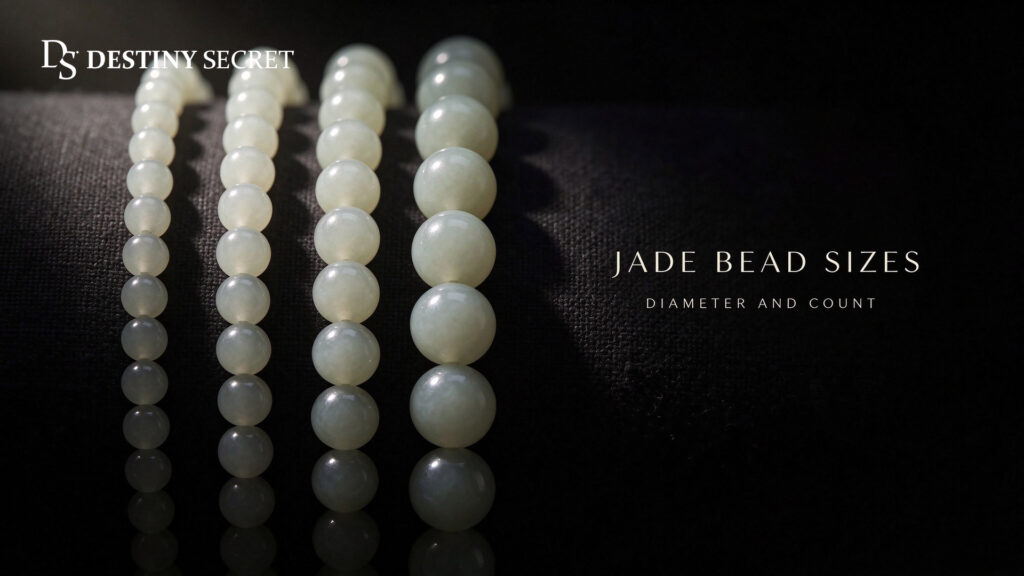
Table of Contents
- Two Numbers, One Strand
- Common Diameters and What They Look Like
- How Many Beads You Need
- Measuring the Wrist
- Fit: Tight, Standard or Loose
- String, Elastic and Knotting
- Bead Size and Price
- Uniformity and Grading
- Longer Strands and Mala Counts
- Which Diameter Suits Whom
- Checks Before Buying
- Care That Follows From Size
- Frequently Asked Questions
Two Numbers, One Strand
A beaded jade bracelet is defined by the diameter of each bead and the number of beads on the strand.
Diameter is measured across a single bead, usually in millimetres, and it governs how the piece reads on the wrist.
Count is what the diameter plus the wrist circumference produces, and it is not a free choice.
A strand of large beads on a small wrist has to drop beads, and a strand of small beads needs more of them.
That relationship is the reason size charts exist at all.
Common Diameters and What They Look Like
Five diameters cover almost every strand sold.
| Diameter | Look on the wrist | Typical wearer |
|---|---|---|
| 6 mm | Fine, almost delicate | Narrow wrists, layered strands |
| 8 mm | The mainstream standard | Most women, most gifts |
| 10 mm | Noticeably present | Wider wrists, single-stone look |
| 12 mm | Bold, individual beads read separately | Men, statement pieces |
| 14 mm and above | Heavy, each bead a feature | Men, collectors |
Eight millimetres is the volume standard because it balances presence against weight.
It also photographs well, which matters more for online selling than most buyers realise.
It also uses rough material efficiently, which keeps prices reachable.
How Many Beads You Need
Bead count follows from wrist circumference divided by bead diameter, plus a small allowance for the string.
| Diameter | Small wrist | Average wrist | Wider wrist |
|---|---|---|---|
| 6 mm | 26–28 | 29–31 | 33–35 |
| 8 mm | 20–22 | 22–24 | 25–27 |
| 10 mm | 16–18 | 18–20 | 20–22 |
| 12 mm | 14–15 | 15–17 | 17–19 |
The three columns correspond to wrists of roughly 15, 17 and 19 centimetres.
The ranges exist because beads are not perfect spheres, and strung gaps vary.
Treat the middle figure as the target and expect one bead either way.
A strand that arrives two beads long can be restrung. One that arrives two short cannot be extended without matching material.
Bangle profiles, by contrast, are sized by internal diameter rather than by count, and Jade Bangle Types covers that method.
Measuring the Wrist
One measurement determines everything downstream, and most people take it wrong.
Wrap a strip of paper or a soft tape around the wrist bone, at the point where a watch sits.
Keep it snug but not tight, then read the length in centimetres.
Add nothing for a beaded strand, since beads sit on top of the skin rather than against it.
A bangle needs a different number entirely, and the two forms are not interchangeable in fit terms, as Jade Bracelet vs Bangle sets out.
Fit: Tight, Standard or Loose
The same wrist supports three fits, and the choice changes both count and comfort.
- Tight: sits above the wrist bone and does not slide, which needs one or two fewer beads.
- Standard: moves about a centimetre and settles below the bone, which is the usual target.
- Loose: hangs to the base of the hand, which adds two or three beads and catches on cuffs.
Loose strands fail faster because the elastic stretches further every time the hand passes through.
Tight strands fail at the knot, since the string carries more tension around a curve.
String, Elastic and Knotting
How the beads are held together affects both fit and lifespan.
| Method | Behaviour | Failure mode |
|---|---|---|
| Elastic cord | Stretches over the hand | Cord perishes, beads scatter |
| Hand-knotted | Fixed length, no stretch | Knots loosen with water |
| Wire with clasp | Adjustable, metal contact | Clasp wears, wire kinks |
Elastic is the most common and the least durable. Cord loses elasticity with heat, sweat and sunlight, usually within two to four years of daily wear.
Hand-knotted strands last longer and fit only one wrist size, since they cannot stretch.
Jade and metal combinations, including clasped strands, sit in Jade and Gold.
Whichever method a strand uses, ask what happens under tension, since that answer predicts how the piece ends.
Bead Size and Price
Larger beads cost disproportionately more, and the reason is material rather than labour.
A 14 mm bead requires a cube of rough roughly twice the volume of an 8 mm bead, and both must be free of flaws.
Flawless material large enough for 14 mm beads is rare, which is why the price step from 10 mm to 12 mm is steep and the step from 12 mm to 14 mm is steeper.
Uniformity adds another premium, since matching twenty beads in colour and transparency wastes more rough than matching fourteen.
The valuation logic behind those steps sits in Jade Value.
Uniformity and Grading
A strand is graded as a whole, and one off-colour bead lowers the grade of the twenty beside it.
Sellers describe strands as uniform, near-uniform or graduated.
Uniform strands hold value best, since replacing a broken bead is possible from a matched spare.
That only works if spares exist, and most sellers do not keep them for a strand sold a year ago.
Graduated strands place the largest bead at the centre and taper toward the clasp, which suits 10 mm and above.
Buy a strand with one or two spare beads if the material is uniform, since a single lost bead otherwise ends the piece.
Longer Strands and Mala Counts
The same diameter logic extends to necklaces and malas, with different count conventions.
A mala uses 108 beads plus a larger marker bead, and the diameter choice decides whether the strand sits at the throat or the sternum.
At 6 mm, 108 beads produce a strand long enough to loop twice.
At 10 mm, the same count becomes a single long strand that hangs to the waist.
Wrist strands and necklaces share diameters but not counts, and Jade Necklace Lengths covers the lengths.
A mala therefore costs more than a bracelet in the same diameter, simply because it uses five times as many beads.
Which Diameter Suits Whom
Four pairings cover most purchases.
- Narrow wrist, everyday: 6 to 8 mm, which stays light through a full day.
- Average wrist, gift: 8 mm, the size that fits without a measurement.
- Wider wrist or a man: 10 to 12 mm, where 8 mm disappears visually.
- Collector or statement: 12 to 14 mm, chosen for material rather than fit.
The second pairing is why 8 mm dominates retail: it is the diameter that most often works without asking.
That convenience cuts both ways, since a gift of 8 mm suits an average wrist and looks undersized on a large one.
Men who buy 8 mm strands usually find them too fine, and Jade Styles for Men gives the width ranges that suit.
Checks Before Buying
Five checks catch most problems on a beaded strand.
- Diameter stated to a tenth of a millimetre rather than rounded.
- Count stated, since a strand priced by weight can hide two missing beads.
- Colour consistent around the full strand, checked in daylight rather than under a lamp.
- No bead with a filled crack, which shows as a bright line under a loupe.
- Cord fresh, with no fraying at the knot.
The second check matters most for value. Two beads missing from a 22-bead strand is a nine per cent material shortfall that no photograph reveals.
Ask for the count in writing, then count on arrival before the cord is cut or the tags removed.
Care That Follows From Size
Small beads fail differently from large ones.
At 6 mm, a single chip removes a visible fraction of the bead and the flaw reads immediately.
At 12 mm, the same chip sits on a larger surface and often goes unnoticed until the strand is restrung.
Small strands therefore need gentler handling, and large strands need more careful checking.
Restringing also differs: twenty small beads take longer to thread than fourteen large ones, and the labour shows in the price of repair.
Elastic strands of any diameter should come off before swimming, since chlorine accelerates cord failure more than any other factor.
Our Jade Bracelets list diameter, bead count and cord type on every strand.
What the stone itself is understood to carry sits in What Is Jade.
Frequently Asked Questions
What size jade beads should I buy?
Eight millimetres suits most women and most gifts. Choose 6 mm for a narrow wrist, and 10 to 12 mm for a wider wrist or for a man.
How many 8 mm beads fit a 16 cm wrist?
Roughly 20 to 22, depending on the fit you want and the gaps between beads. Tight fits take one or two fewer.
Are bigger jade beads worth more?
Yes, and disproportionately so. Larger flawless beads require much more rough material, so price rises faster than diameter.
Is elastic or knotted jade better?
Hand-knotted lasts longer and fits only one wrist size. Elastic is easier to put on and perishes within a few years of daily wear.
Bead counts are estimates based on typical strand construction. Exact counts vary with bead shape, string thickness and fit preference.
Browse the full Jade Collection at Destiny Secret.