
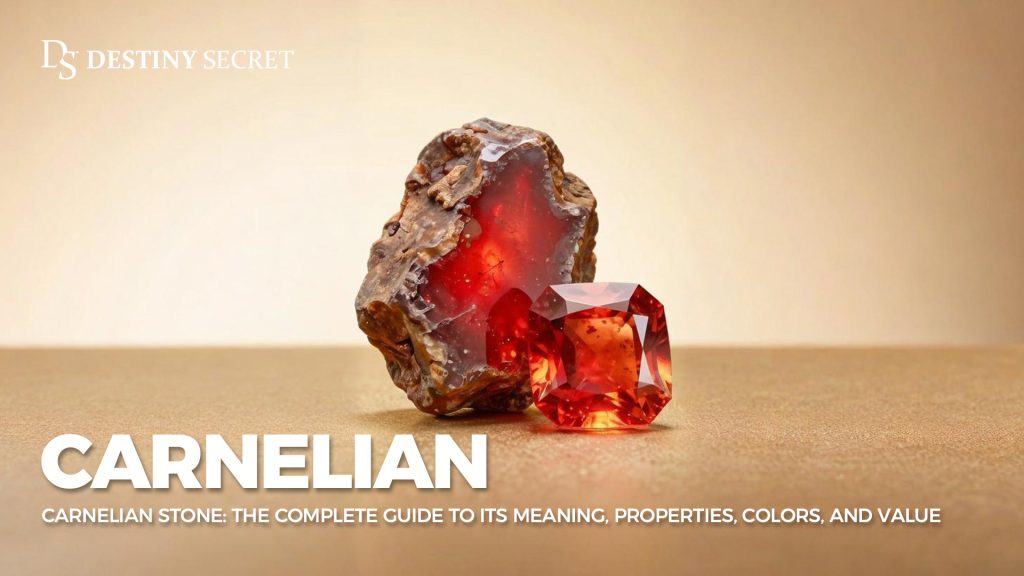
Imagine a stone that glows like the setting sun, radiating warmth, energy, and life. A stone that has been called the “Artist’s Stone” for its power to inspire creativity, the “Stone of Courage” for its ability to dispel fear, and the “Stone of Ambition” for its drive toward success. This is carnelian—a gemstone as vibrant and dynamic as the fire it seems to hold within.
For thousands of years, carnelian has captivated humanity. Ancient Egyptian pharaohs wore carnelian amulets to guide them through the afterlife. Roman legions carried carnelian seals and signet rings, using them to stamp official documents and letters. Islamic artisans carved carnelian into prayer beads and talismans. And across the world, from India to Greece, this warm orange-red stone has been revered as a source of vitality, courage, and creative fire.
But what exactly makes carnelian so special? Where does its warm, fiery color come from? Why has it been used in seals and amulets for millennia? What are its healing properties, and how can you tell genuine carnelian from imitations?
In this complete guide, we’ll answer all these questions and more. You’ll discover the geology behind carnelian’s signature color, explore the factors that determine its quality, uncover its profound meaning across cultures and centuries, learn its traditional healing properties, and gain practical knowledge for identifying authentic stones. By the end, you’ll understand why carnelian has earned its place as one of the world’s most beloved and enduring gemstones.
Table of Contents
What Is Carnelian Stone?
The Colors and Quality of Carnelian: From Orange-Red to Deep Red
The Meaning and Symbolism of Carnelian Across History
The Properties of Carnelian: Physical and Energetic
Carnelian Value, Quality, and How to Identify Genuine Stone
Where Is Carnelian Found? A Guide to Major Sources
How to Use and Care for Your Carnelian Jewelry
Frequently Asked Questions About Carnelian Stone
Research and References
Conclusion: Embracing the Fire of Carnelian
Explore Our Carnelian Bracelets
1. What Is Carnelian Stone?
Carnelian is a variety of chalcedony—a form of quartz—known for its warm, vibrant colors ranging from pale orange to deep reddish-brown. For over five thousand years, people have prized this stone for its beauty, durability, and energetic properties.
The Science of Carnelian
Chemically, carnelian is silicon dioxide (SiO₂), the same compound that makes up quartz, amethyst, agate, and many other gemstones. It belongs to the cryptocrystalline quartz family, which means its microscopic crystals are too small to see with the naked eye. This fine-grained structure gives carnelian its smooth, waxy luster and excellent durability.
The warm colors of carnelian come from iron oxide impurities—essentially microscopic rust particles suspended within the quartz. When the stone forms, varying amounts and oxidation states of iron create different shades. Low iron content produces pale orange or salmon colors, while higher concentrations create deep reds and browns.
Unlike transparent gemstones such as amethyst or citrine, carnelian is typically translucent to opaque. Light penetrates the surface but doesn’t pass through clearly, creating a soft, glowing effect that seems to radiate warmth from within.
Carnelian vs. Sard vs. Agate: Understanding the Differences
Carnelian belongs to a family of closely related chalcedony varieties. Understanding these distinctions helps you appreciate what makes carnelian unique.
Carnelian: Typically orange to reddish-orange. The color is warm, vibrant, and relatively uniform. The name comes from the Latin carnis (flesh), referring to the stone’s flesh-like color.
Sard: A darker, browner variety of carnelian. Sard ranges from deep reddish-brown to brown. Some gemologists consider sard a separate variety, while others treat it as simply a darker carnelian.
Agate: Like carnelian, agate is banded chalcedony. Carnelian can occur within agates as distinct bands. When orange bands alternate with white or other colors, the stone is properly called carnelian agate.
Sardonyx: A banded variety combining sard and white chalcedony layers. Sardonyx was extremely popular in ancient Roman and Greek seal carving.
The Name's Ancient Origins
The name “carnelian” has a fascinating etymological history. It derives from the Latin cornum (cornel cherry), whose bright red fruits resemble the stone’s color. The alternative spelling “cornelian” comes from the same root. The Latin carnis (flesh) also influenced the name, referencing the stone’s warm, flesh-like tones.
In various languages, carnelian’s name reflects its fiery appearance. Arabic calls it aqeeq yamani, while Persian uses yamani. Many cultures have independently named this stone after fire, sun, or blood—testament to its universal appeal.
Is Carnelian a Precious Stone?
In traditional gemology, carnelian is classified as a semi-precious gemstone. It’s generally more affordable than precious stones like diamonds, rubies, or emeralds, making it accessible to a wide range of collectors and jewelry lovers.
However, its historical and cultural significance rivals that of many precious stones. In ancient Egypt, carnelian was valued alongside turquoise and lapis lazuli. Roman emperors wore carnelian signet rings. The Prophet Muhammad reportedly wore a carnelian ring. In terms of cultural importance, carnelian stands among the most treasured materials in human history.
2. The Colors and Quality of Carnelian: From Orange-Red to Deep Red
The beauty of carnelian lies in its warm, fiery colors. Understanding the color spectrum and quality factors helps you appreciate and select fine carnelian.
The Carnelian Color Spectrum
Carnelian displays a remarkable range of warm hues:
| Color | Description | Rarity | Appeal |
|---|---|---|---|
| Pale Orange | Soft, salmon-like orange | Common | Gentle, subtle, affordable |
| Vibrant Orange | Bright, saturated orange | Common | Classic carnelian, widely loved |
| Orange-Red | Orange with strong red undertones | Moderately common | Rich, warm, highly desirable |
| Red Carnelian | Deep, blood-red to brick-red | Less common | Intense, dramatic, premium |
| Brownish-Red | Red with brown undertones | Common (often called sard) | Earthy, grounding, distinctive |
| Deep Red-Brown | Very dark, almost opaque red-brown | Rare | Moody, sophisticated, valuable |
What Makes Carnelian More Valuable?
Several factors determine carnelian’s value, with color being the most important.
1. Color Saturation and Warmth
The most desirable carnelian exhibits a vivid, warm orange-red—neither too pale nor too dark. The color should appear rich and saturated, with a lively, fiery quality. Stones that lean too brown or too pale are less valuable. The ideal carnelian seems to glow from within when held up to light.
2. Uniformity
High-quality carnelian has even color distribution across the entire stone. Patches, bands, or swirls of different colors generally reduce value, though some banded carnelian agates have their own appeal. The finest carnelian appears consistently colored from every angle.
3. Clarity and Translucency
Carnelian is typically translucent, allowing some light to pass through. The best stones have good translucency with minimal visible inclusions or cloudy areas. When you hold quality carnelian up to a light source, it should glow warmly.
Stones that are too opaque or contain visible fractures, pits, or dark spots are less desirable.
4. Cut and Polish
Well-cut carnelian with a smooth, even surface and good polish shows off the stone’s warm glow best. Cabochon cuts (domed, polished surfaces) are most common for carnelian jewelry, as the curved surface enhances the stone’s translucency and color depth.
5. Treatment
Natural, untreated carnelian is most prized. However, much of the carnelian on the market has been heat-treated to enhance or alter its color. Understanding treatments helps you make informed purchasing decisions.
Natural vs. Heat-Treated Carnelian
Heat treatment is extremely common for carnelian. In fact, most carnelian sold today has been heated.
Natural Carnelian: Forms with its color naturally from iron oxide inclusions. Natural carnelian tends to have softer, more subtle colors—pale orange, salmon, or gentle reddish-orange.
Heat-Treated Carnelian: When certain chalcedony (particularly brownish sard) is heated, iron compounds within the stone oxidize and turn warm red or orange. This process mimics what happens naturally over millions of years but accomplishes it in hours.
Heat treatment is generally considered acceptable in the gem trade, as it’s stable and permanent. However, sellers should disclose treatment. Untreated natural carnelian in vibrant colors is rare and commands premium prices.
3. The Meaning and Symbolism of Carnelian Across History
Few gemstones carry as rich and continuous a history as carnelian. For over five thousand years, across civilizations that spanned the globe, this warm orange-red stone has been associated with courage, creativity, vitality, and protection.
Ancient Egypt: The Stone of the Sun and the Afterlife
The ancient Egyptians called carnelian the “Stone of the Sun” and associated it with the divine fire of Ra. They placed carnelian amulets in tombs to guide the deceased through the underworld, believing the stone’s warm glow would light the way.
Carnelian appears prominently in Egyptian jewelry, including the treasures of Tutankhamun. The Egyptians also carved carnelian into scarabs, heart amulets, and protective talismans. They believed carnelian could calm the spirit, warm the heart, and protect against evil.
Ancient Rome and Greece: The Seal of Authority
The Romans prized carnelian above almost any other gemstone for one specific purpose: signet rings and seals. Carnelian’s smooth surface and excellent hardness made it ideal for carving intaglios—designs carved into the stone that would leave raised impressions when pressed into wax or clay.
Roman officials, merchants, and emperors used carnelian signet rings to stamp official documents, seal letters, and mark ownership. The most famous example is the “Ring of Polycrates,” though carnelian rings appear throughout Roman history.
The Romans also believed carnelian brought courage in battle and protection from harm. Roman soldiers wore carnelian amulets for bravery and good fortune.
Islamic Traditions: The Prophet's Ring
In Islamic tradition, carnelian holds special significance. The Prophet Muhammad reportedly wore a carnelian ring set in silver, using it as a seal. Carnelian is known as the “Stone of Medina” and appears in many Islamic texts and traditions.
Muslim artisans have carved carnelian into prayer beads, amulets, and rings for centuries. The stone is associated with the Prophet and is believed to bring blessings, protection, and spiritual insight.
Tibetan and Buddhist Traditions
In Tibetan Buddhism, carnelian is one of the “jewel stones” used in malas (prayer beads) and ritual objects. Its warm, vibrant color represents the fire of transformation and the energy of life. Tibetan healers have used carnelian for centuries to warm cold conditions and stimulate vitality.
Renaissance and Victorian Eras
During the Renaissance, carnelian remained popular for intaglio carving. Artists carved classical scenes, portraits, and mythological figures into carnelian, set into rings and brooches.
The Victorian era saw a revival of interest in carnelian, particularly in cameos and seal rings. Queen Victoria herself owned carnelian jewelry, and the stone appeared in many sentimental and mourning pieces.
Modern Meaning: Creativity, Courage, and Vitality
Today, carnelian carries forward many of these ancient associations. It is widely regarded as:
The Stone of Creativity: Carnelian is believed to stimulate artistic expression, imagination, and creative flow. Artists, writers, and musicians often use it to overcome creative blocks.
The Stone of Courage: The warm, fiery energy of carnelian is thought to dispel fear, boost confidence, and provide courage to face challenges.
The Stone of Vitality: Carnelian is associated with life force, energy, and passion. It’s believed to awaken the body, increase motivation, and enhance physical stamina.
The Stone of Ambition: For those seeking success, carnelian is thought to sharpen focus, drive ambition, and attract opportunities.
The Stone of Protection: Like the Egyptians who placed it in tombs, many today carry carnelian for protection against negativity, envy, and ill will.
Modern Associations
In contemporary crystal healing, carnelian is the birthstone for July (along with ruby) and the traditional gift for the 17th wedding anniversary. It remains one of the most popular stones for meditation, creative work, and energy healing.
4. The Properties of Carnelian: Physical and Energetic
Physical Properties: Understanding Your Stone
Knowing the physical properties of carnelian helps you appreciate its unique character and care for it properly.
| Property | Value |
|---|---|
| Chemical Formula | SiO₂ (silicon dioxide) |
| Mineral Class | Quartz (cryptocrystalline chalcedony) |
| Crystal System | Trigonal (microcrystalline) |
| Color | Pale orange to deep orange-red to reddish-brown |
| Luster | Vitreous to waxy |
| Transparency | Translucent to opaque |
| Mohs Hardness | 6.5 to 7 |
| Specific Gravity | 2.58 to 2.64 |
| Fracture | Conchoidal to uneven |
| Streak | White |
Durability: With hardness of 6.5 to 7, carnelian is durable enough for everyday wear. It resists scratching from most common materials, though harder stones like quartz, topaz, and diamond can scratch it. Its toughness (resistance to breaking) is good, making it suitable for rings, bracelets, and other jewelry that may experience minor impacts.
Porosity: Carnelian is non-porous, meaning it doesn’t absorb liquids or oils easily. This makes it relatively low-maintenance compared to more porous stones like turquoise or lapis lazuli. However, it can still be damaged by harsh chemicals or extreme heat.
Energetic Properties: Traditional Beliefs and Crystal Healing
While not scientifically proven, carnelian has carried various energetic properties across many cultures and healing traditions. Understanding these beliefs adds depth to your appreciation of the stone.
Chakra Associations:
-
Sacral Chakra (Svadhisthana): Carnelian’s strongest association is with the sacral chakra, located in the lower abdomen. This chakra governs creativity, sexuality, passion, and emotional expression. Carnelian is believed to awaken and balance this energy center.
-
Root Chakra (Muladhara): The deeper red varieties of carnelian also connect to the root chakra, which governs survival, security, and grounding.
-
Solar Plexus Chakra (Manipura): Some practitioners associate carnelian’s warm energy with the solar plexus, the center of personal power, confidence, and will.
Emotional and Spiritual Benefits (Traditional Beliefs):
-
Creativity: Carnelian is believed to stimulate artistic expression, break through creative blocks, and inspire new ideas. Writers, painters, musicians, and other creatives often work with carnelian.
-
Courage: The stone is thought to dispel fear, boost self-confidence, and provide the courage to take risks or face difficult situations.
-
Vitality and Motivation: Carnelian is said to awaken the body, increase physical energy, and sharpen motivation. It’s often used to combat lethargy or apathy.
-
Emotional Balance: The warm, stabilizing energy of carnelian is believed to calm anger, reduce envy, and promote emotional equilibrium.
-
Protection: Like the Egyptians who placed it in tombs, carnelian is considered a protective stone, shielding the wearer from negativity, envy, and ill will.
-
Ambition and Success: Carnelian is thought to sharpen focus, clarify goals, and attract success in business and personal endeavors.
Modern Perspective: At Destiny Secret, we’ve heard from many customers who feel a sense of renewed energy, creative inspiration, or quiet courage when wearing their carnelian pieces. Whether these feelings come from the stone itself, the power of intention, or simply the beauty of the gem, the experience is real and meaningful to each individual.
5. Carnelian Value, Quality, and How to Identify Genuine Stone
What Determines Carnelian Value?
Several factors influence the value of carnelian, with the finest pieces commanding premium prices.
1. Color
Color is the most important factor. The most valuable carnelian exhibits a vivid, warm orange-red—neither too pale nor too dark. Stones with a bright, saturated color that seems to glow are most desirable. Pale orange or brownish stones are less valuable.
2. Uniformity
High-quality carnelian has even color distribution across the entire stone. Patches, bands, or color zoning generally reduce value, though some banded carnelian agates have their own market.
3. Translucency
The best carnelian has good translucency, allowing light to penetrate and create a warm, glowing effect. Stones that are too opaque or too cloudy are less desirable.
4. Clarity
Carnelian should be relatively free of visible inclusions, fractures, or pits. Stones with cracks, dark spots, or other imperfections are less valuable.
5. Cut and Polish
Well-cut carnelian with a smooth, even surface and good polish shows off the stone’s warm glow best. Poor cutting or rough polish reduces value.
6. Treatment
Natural, untreated carnelian in vibrant colors is rare and commands the highest prices. However, most carnelian on the market has been heat-treated. Heat-treated stones are generally more affordable but still beautiful.
How to Tell If Carnelian Is Real
Carnelian is occasionally imitated or misrepresented. Here’s how to spot genuine stone.
Visual Inspection:
Look for natural variations: Genuine carnelian has subtle variations in color and translucency. Perfectly uniform color with no variation may indicate dyeing or imitation.
Check for banding: Some carnelian displays subtle banding or color zoning. Completely flat, uniform appearance can be a red flag.
Examine surface: Real carnelian has a smooth, waxy to vitreous luster. Plastic or resin imitations look too glossy or feel too light.
Simple Tests:
Temperature Test: Real carnelian feels cool to the touch initially. Plastic or resin imitations warm up quickly.
Hardness Test: Carnelian (hardness 6.5-7) can scratch glass and cannot be scratched by a steel knife. Test carefully on an inconspicuous spot.
Weight Test: Real stone feels heavier than plastic or glass imitations of the same size.
Common Imitations and Treatments:
| Imitation/Treatment | What It Is | How to Spot |
|---|---|---|
| Dyed Agate | Gray or white agate dyed orange-red | Color pools in cracks; unnatural uniformity; dye may appear in bands |
| Dyed Quartz | Clear or milky quartz dyed orange | No natural color variation; color may appear streaky |
| Glass Imitation | Colored glass molded to look like carnelian | Too glossy; may have bubbles; feels lighter; temperature warms quickly |
| Plastic/Resin | Molded plastic or resin | Too light; scratches easily; warm to the touch; may have mold marks |
| Heat-Treated Sard | Brown sard heated to become red-orange carnelian | Acceptable treatment; generally disclosed; color appears natural |
The Most Important Rule: Buy from reputable sources. At Destiny Secret, every carnelian piece is carefully sourced from trusted suppliers who guarantee authenticity. We believe you should never have to wonder whether your stone is real.
6. Where Is Carnelian Found? A Guide to Major Sources
Carnelian deposits exist in many locations worldwide, each producing stones with slightly different characteristics.
| Country/Region | Notable Sources | Characteristics |
|---|---|---|
| India | Gujarat, Maharashtra, Rajasthan | Major modern producer. Indian carnelian ranges from pale orange to deep red. Much of the world’s carnelian comes from India. |
| Brazil | Rio Grande do Sul | Significant producer. Brazilian carnelian often has good translucency and warm colors. |
| Uruguay | Artigas region | Known for high-quality carnelian agates with distinct banding. |
| Madagascar | Various | Produces carnelian with unique color variations, including deep reds. |
| United States | Oregon, California, Washington | Smaller deposits. Oregon produces some distinctive carnelian. |
| Australia | Queensland | Produces carnelian, often in agate formations. |
| Egypt | Sinai Peninsula | Historical source; ancient Egyptian carnelian came from here. Now largely depleted. |
| Germany | Idar-Oberstein region | Historical source; famous for carnelian carving tradition. Now mostly depleted. |
| Russia | Siberia | Produces carnelian, though less commercially significant. |
| Peru | Various | South American source with distinctive characteristics. |
Note on Indian Carnelian: India is currently the world’s largest producer of carnelian. The Cambay region (Gujarat) has been a major source for centuries. Indian carnelian ranges widely in quality, from commercial-grade material to fine, deep red stones.
Note on Historical Sources: Ancient Egypt sourced carnelian from the Sinai Peninsula, while the Romans obtained it from India and Egypt. The famous Idar-Oberstein region in Germany became a carving center using locally sourced carnelian, though those deposits are now depleted.
7. How to Use and Care for Your Carnelian Jewelry
Carnelian is durable (hardness 6.5-7) and non-porous, making it suitable for everyday wear with proper care. Follow these guidelines to keep your carnelian pieces looking their best.
How to Use Carnelian for Creativity and Vitality
Beyond wearing it as jewelry, you can use carnelian in various ways:
Wear it near the sacral chakra: A pendant or bracelet positions the stone over the lower abdomen, supporting creative energy and passion.
Meditate with it: Hold a piece of carnelian during meditation to awaken creative flow and connect with your inner fire.
Place it on your creative workspace: Keep carnelian on your desk or studio to inspire artistic expression and break through blocks.
Create a crystal grid: Combine carnelian with other stones like citrine or clear quartz for enhanced creativity and motivation.
Use during physical activity: Many athletes carry carnelian for its energizing properties.
Hold during challenging conversations: Carnelian is believed to promote courage and clear communication.
Do's and Don'ts of Carnelian Care
✅ DO:
Clean gently with warm water and mild soap. Use a soft cloth or brush.
Dry thoroughly after cleaning to prevent water spots.
Store separately in a fabric-lined jewelry box or soft pouch to prevent scratching by harder gems.
Remove jewelry before vigorous activities that might cause impact.
Recharge in moonlight or sunlight—many crystal enthusiasts believe carnelian’s energy is refreshed by light exposure.
❌ DON’T:
Avoid harsh chemicals – including bleach, ammonia, and jewelry cleaning solutions.
Don’t use ultrasonic or steam cleaners – these can damage the stone.
Avoid prolonged sun exposure – colors may fade slightly over time with intense direct sunlight (though carnelian is generally color-stable).
Don’t expose to extreme heat or sudden temperature changes.
Avoid scratching – while carnelian is durable, harder materials like topaz, sapphire, or diamond can scratch it.
Cleansing and Charging
For those who work with crystal energies, regular cleansing and charging is recommended:
Cleanse: Run under lukewarm water, smudge with sage, or place on a selenite charging plate.
Charge: Place in sunlight (morning sun is gentle) or moonlight overnight. Carnelian is one of the few stones that many practitioners charge in sunlight, as its solar energy aligns with the sun.
Program: Hold the stone with intention, visualizing the energy you wish to attract (creativity, courage, vitality, etc.).
8. Frequently Asked Questions About Carnelian Stone
What is carnelian stone good for?
Carnelian is traditionally used for creativity, courage, vitality, and motivation. It’s also valued for emotional balance, protection, and attracting success.
What color is carnelian stone?
Carnelian ranges from pale orange to vibrant orange-red to deep reddish-brown. The most desirable color is a vivid, warm orange-red.
Is carnelian a precious stone?
Carnelian is technically classified as a semi-precious gemstone. It’s generally more affordable than precious stones but has rich historical and cultural significance.
How can you tell if carnelian is real?
Look for natural color variations, good translucency, and a smooth, waxy luster. Perform temperature and weight tests. Buy from reputable sources.
What is the difference between carnelian and sard?
Sard is a darker, browner variety of chalcedony. Some consider sard a separate stone, while others treat it as simply a darker carnelian. Sard typically has less red and more brown.
Is carnelian heat-treated?
Most carnelian on the market has been heat-treated to enhance its color. Natural, untreated carnelian in vibrant colors is rare and more valuable.
What chakra is carnelian associated with?
Carnelian is primarily associated with the sacral chakra (creativity, passion, emotions). Deeper red varieties also connect to the root chakra.
How much is carnelian worth?
Carnelian is generally affordable. Common carnelian can cost just a few dollars per piece, while fine-quality natural carnelian with deep, vibrant color can command higher prices.
Where is carnelian found?
Major sources include India (largest producer), Brazil, Uruguay, Madagascar, the United States, and Australia. Historical sources include Egypt and Germany.
What is the spiritual meaning of carnelian?
Carnelian symbolizes creativity, courage, vitality, and protection. It’s known as the “Artist’s Stone” for inspiring creativity and the “Stone of Courage” for dispelling fear.
9. Research and References
This guide draws upon multiple authoritative sources in the fields of gemology, mineralogy, archaeology, and cultural history:
Gemological Institute of America (GIA). “Chalcedony: Carnelian.” GIA Gem Encyclopedia, 2023.
Mindat.org. “Carnelian: Mineral Information, Data and Localities.” 2023.
International Gem Society (IGS). “Carnelian Value, Price, and Information.” 2023.
Geology.com. “Carnelian: A translucent orange to red variety of chalcedony.” Hobart M. King, PhD.
British Museum. “Carnelian in Ancient Egypt and Rome.” Research Publication, 2022.
Hall, Judy. “The Crystal Bible: A Definitive Guide to Crystals.” Walking Stick Press, 2003.
Simmons, Robert & Ahsian, Naisha. “The Book of Stones: Who They Are and What They Teach.” North Atlantic Books, 2015.
Smithsonian National Museum of Natural History. “Gemstones of the Ancient Mediterranean.” Collection Guide, 2023.
Gem-A (Gemological Association of Great Britain). “The Carnelian Sources of Gujarat, India.” Research Publication, 2023.
Mineralogical Society of America. “Iron Oxides in Chalcedony.” American Mineralogist, Volume 107, 2022.
10. Conclusion: Embracing the Fire of Carnelian
As we’ve discovered, carnelian is far more than just a beautiful orange-red stone. It’s a gem with one of the longest and most continuous histories of any ornamental material on Earth. From the tombs of Egyptian pharaohs to the signet rings of Roman emperors, from the prayer beads of Islamic tradition to the creative studios of modern artists, carnelian has been cherished, carved, and revered for over five thousand years.
Its appeal is both timeless and universal. The warm, fiery color—evoking the sun, fire, and life itself—captures something essential in the human spirit. The smooth, translucent surface invites touch and contemplation. And the meaning behind it all—creativity, courage, vitality, protection—speaks to desires we all share.
Whether you’re drawn to carnelian as a stone of creative inspiration, a tool for building courage, a source of vital energy, or simply because its warm glow brings you joy, you’re participating in a tradition that spans millennia. The next time you hold a piece of carnelian, you’re not just holding a stone—you’re holding a piece of human civilization, a spark of creative fire, and a connection to the sun that has warmed humanity since the beginning of time.
11. Explore Our Carnelian Bracelets
If this guide has deepened your appreciation for carnelian, you might be interested in experiencing its warm, vital energy firsthand. At Destiny Secret, we carry a carefully curated selection of genuine carnelian bracelets, each piece chosen for its quality, color, and character.
From vibrant orange-red carnelian that seems to glow with inner fire to deeper, more dramatic reddish-brown stones, our collection showcases the full spectrum of this remarkable gemstone. Each bracelet is handcrafted with care, honoring the traditions that have made carnelian beloved for millennia.
Visit our Carnelian Bracelets page to explore the collection. Whether you’re seeking a stone of creativity, a talisman of courage, a source of vitality, or simply a beautiful piece of jewelry with a rich history, you’ll find carnelian pieces that resonate with your journey and connect you to the eternal fire of this ancient stone.
Hahahaha You are so good