
Spacer beads for bracelets do three jobs at once, and most buyers only notice one of them. They break a long run of stone into readable sections. They add a metal accent without adding a charm. And they change the finished length, which is the job nobody plans for.
A single gold cylinder between two runs of stone is the most common arrangement in the market, and it is also the most useful. One spacer marks the centre. Two mark symmetry. Three start to read as a design rather than an accent, and that is a different piece of jewellery.
The strands in beaded bracelets each carry one gold cylinder spacer, so the proportions below can be checked against a real piece rather than a diagram.
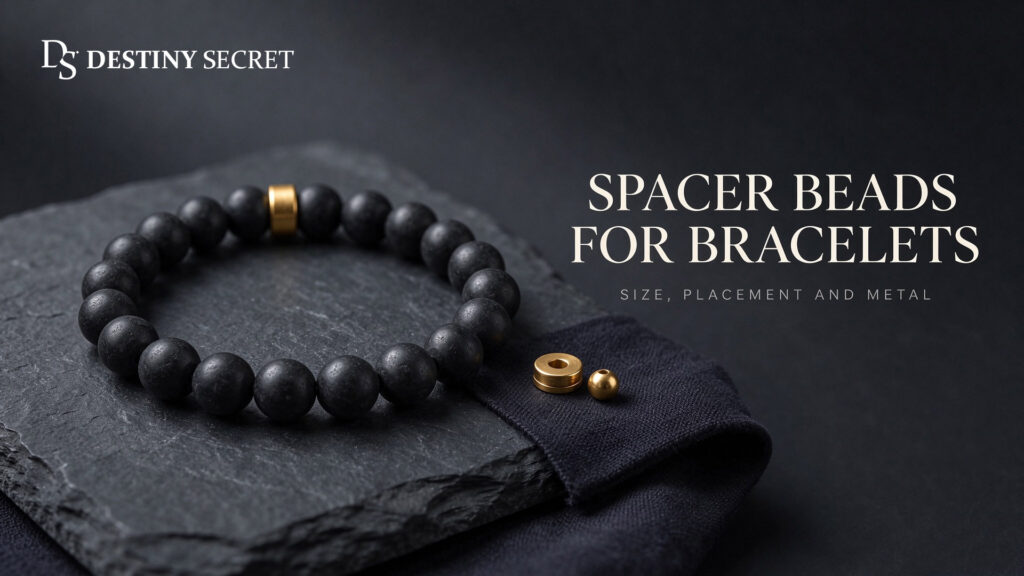
Table Of Contents
- What a Spacer Bead Actually Does
- Spacer Types and Their Jobs
- How Size Relates to Bead Diameter
- Symmetry: One, Two or Three
- Spacers and Bead Count
- Metal Grade: Plated, Gold-Filled, Solid
- Spacers on Stretch Bands
- Spacers and the Centre Line
- Fit and Comfort
- Cost: What the Spacer Adds
- Care and How Plating Ages
- Choosing Spacer Beads for a Strand
- Frequently Asked Questions
What a Spacer Bead Actually Does
The term covers a wide field, and spacer beads for bracelets split into two families: metal accents and textural interruptions. A spacer is any bead that is not the main stone and is not a charm. It interrupts the rhythm of the strand. That interruption is the whole point: a uniform run of identical beads reads as a plain line from a metre away, and a single break makes the line legible.
It also protects. Metal sits between stone beads and takes the abrasion that would otherwise fall on the softest bead in the row. On a strand of mixed hardness, that matters more than the look.
And it carries meaning. A gold cylinder at the centre reads as deliberate. The same cylinder repeated three times reads as decoration. Same material, different message.
Spacer Types and Their Jobs
Five types cover almost everything sold as spacer beads for bracelets, and they are not interchangeable. Each has a size relationship to the main bead and a job it does better than the others.
Type | Typical size | Does best | Watch for |
|---|---|---|---|
Metal cylinder | Same diameter as bead | Marks the centre, adds accent | Plating wear |
Rondelle disc | Thin, wider than bead | Separates two stone types | Edge wear on stone |
Small metal bead | Half bead size | Quiet rhythm between beads | Reads as filler if repeated |
Wood or lava | Same or larger | Texture contrast, matte finish | Absorbs oils |
Glass or crystal | Same diameter | Light break in a dark strand | Fragile at the hole |
How Size Relates to Bead Diameter
The first rule of spacer beads for bracelets is diameter matching. A spacer should match the main bead in diameter, or sit deliberately smaller. Matching keeps the strand a single tube. Smaller creates a notch, and a notch reads as a mistake unless it repeats.
Larger is almost always wrong on a bracelet. A spacer wider than the beads becomes the widest point of the band, and that point takes every knock against a table edge.
Thickness is a separate number from diameter. A 2 mm thick rondelle between 8 mm beads adds length without adding width, which is how a strand gains rhythm without gaining bulk. Beaded Bracelet Styles shows where that reads as elegant and where it reads as noisy.
Symmetry: One, Two or Three
The second rule of spacer beads for bracelets is placement. One spacer belongs at the centre, directly opposite the join or the clasp. That is the arrangement that makes a plain strand look considered, and it is the default for a first piece.
Two spacers should sit opposite each other, dividing the strand into halves. Placed at random, they look like leftovers. Two is also the arrangement that best suits a watch worn on the same wrist, because the metal sits away from the watch case.
Three or more turn the spacer into a pattern. That is a legitimate design, but it stops being an accent and starts setting a rhythm, and the bead count between spacers then has to be equal or the pattern shows.
Spacers and Bead Count
Most confusion about spacer beads for bracelets comes down to counting. Every spacer takes the place of a bead, so it changes the maths. An 18 cm band of 8 mm beads holds roughly 22 beads. Replace one with a spacer and the count drops to 21 stone beads plus metal.
The overall length stays close to the same only if the spacer matches the bead in diameter and thickness. A thin disc frees length; a thick cylinder eats it. How Many Beads per Bracelet works through the count by diameter and wrist size.
The practical rule is to fit the strand after the spacer is in place, not before. Adjusting around a metal bead is easier than rebuilding the whole row.
Metal Grade: Plated, Gold-Filled, Solid
Three grades are sold under similar names, and they age differently. Plated brass carries a thin gold layer over a base metal. Gold-filled carries a thick layer bonded to brass, legally a different product. Solid gold is the metal all the way through.
Plated is the common choice at lower price points and the one that dulls first, usually at the edges where the bead meets stone. Gold-filled holds colour for years under daily wear. Solid is a lifetime purchase.
For a strand worn daily, gold-filled is the sensible middle. The price difference against plated is small next to the cost of replacing a spacer that has started to show grey. Bead Material and Finish sets out how each grade behaves against sweat and chlorine.
Spacers on Stretch Bands
The stringing order that keeps a metal bead stable is set out in Beaded Bracelet Stringing. On stretch cord, spacer beads for bracelets need two extra rules. Spacers work on elastic, but they need care. A metal bead against elastic cord abrades the wrap faster than stone does, because metal edges are sharper and the cord moves under load.
Two habits reduce that. Keep the spacer away from the knot, and keep it away from the bead that sits at the top of the wrist where the band flexes most. Two join types tolerate a metal bead beside them without loosening. Stretch cord fails at single points rather than evenly, which is why one break ends the band.
On a stretch band, the spacer should also be the same diameter as the beads. A wider metal bead on elastic creates a hard edge that the cord pulls against every time the band goes on.
Spacers and the Centre Line
The centre of a bracelet is the part that faces up when the arm rests on a table. That is why a single spacer is placed there: it is the bead most often seen, and the least often touched.
If the strand carries a charm or a pendant, the charm takes the centre and the spacer moves to either side of it. Two spacers flanking a charm is a standard composition, and it stops the charm from sliding along the strand.
Without a charm, the spacer is the only fixed point on the band. It is also the reference that tells the wearer which way the strand should sit.
Fit and Comfort
Comfort is the half of spacer beads for bracelets that rarely gets discussed. A spacer adds weight where the band meets the wrist bone, and a heavy one is noticeable after an hour. On a small wrist, a wide metal cylinder can press against the tendon at the base of the hand.
Comfort usually improves when the spacer is thin rather than tall. A disc distributes pressure; a cylinder concentrates it on one spot.
If the band is sized close to the wrist, keep the spacer small or move it off centre by one bead. That single bead of offset removes most of the pressure complaint, and it costs nothing to plan in.
Cost: What the Spacer Adds
A spacer is a small share of the material cost and a large share of the perceived value. That is why a strand with one metal bead often sells at a step above the same stones without one.
The honest comparison is between two finished bands, not between a spacer and its weight in metal. Metal weight in a 6 mm cylinder is negligible; the labour of aligning it is what the price reflects.
Where the cost turns is replacement. A plated spacer that dulls cannot be re-plated at home, so the whole band usually gets rebuilt. Gold-filled avoids that rebuild, which is why it is worth the difference on a piece worn daily.
Care and How Plating Ages
Plated metal dislikes three things: chlorine, perfume and abrasive cloth. Each removes a little of the layer, and the loss shows first at the edges.
Wipe the band with a dry soft cloth after wear rather than polishing it. Polishing cloth removes tarnish and plating at the same rate. How to Care for Beaded Bracelets covers the routine for mixed-material strands.
If the spacer has already started to show a grey rim, the layer is gone at that edge and no amount of cleaning brings it back. That is the moment to plan a rebuild rather than a clean.
Choosing Spacer Beads for a Strand
Match diameter to the main bead. Choose thin over tall. Put one at the centre before considering two. Keep the grade appropriate to how often the band will be worn.
Those four rules answer most questions about spacer beads for bracelets, and they cost nothing to apply before the strand is strung rather than after.
How to Restring a Bracelet covers the rebuild when a spacer finally dulls, and What Are Beaded Bracelets explains how the parts of a strand fit together.
Frequently Asked Questions
How many spacer beads should a bracelet have?
One at the centre is the standard. Two sit opposite each other. Three or more becomes a pattern and needs equal bead counts between them.
Are spacer beads for bracelets always metal?
No. Wood, lava, glass and crystal all work as spacers. Metal is the most common because it holds a clean edge and reads as deliberate.
Should spacer beads be the same size as the main beads?
Yes, in diameter. Thickness is separate, and a thin disc adds rhythm without adding bulk to the band.
Do spacer beads make a bracelet longer?
They replace a bead rather than add to it. A spacer the same size as the bead changes nothing; a thin one frees a little length.
What is the difference between gold-filled and gold-plated spacers?
Gold-filled carries a thick bonded layer and holds colour for years. Plated carries a thin layer that dulls at the edges, usually within a year of daily wear.
Every Destiny Secret strand is handcrafted and unique, with a single gold cylinder spacer placed at the centre rather than added as an afterthought.
Natural stone varies from piece to piece. Photographs are indicative, and colour may differ on your screen. Metal grades are described by construction rather than by a claimed thickness.