
Mens beaded bracelet styles are decided by three signals before any stone is chosen: the finish, the metal and whether the strand stands alone. Change one of those and the same beads read as a different piece. The male range is narrower than the unisex one, which is why a handful of versions account for most of what sells.
Most of the decision is made before the stone is even considered. What separates a considered bracelet from a costume one is rarely the material. It is whether the diameter matches the wrist, whether the finish suits the rest of the outfit, and whether the metal repeats something already being worn. Where finish decides the read, Mens Beaded Bracelets describes surface and metal separately for each piece.
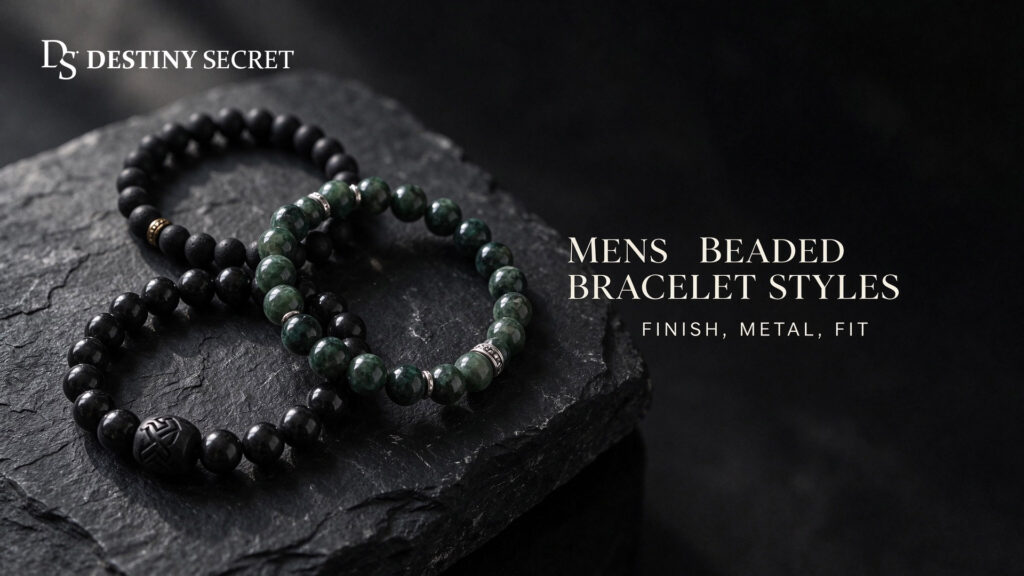
Table Of Contents
- Three Style Signals in the Male Range
- The Single Matte Strand
- Polished Stone and the Dress End
- Spacer-Accented Strands
- Bead and Leather Combinations
- Symbol and Talisman Styles
- Stacking With a Watch
- Colour Discipline
- Diameter by Style
- What Ages Well
- Fitting the Style to the Wardrobe
- Buying the Right Version
- Frequently Asked Questions
Three Style Signals in the Male Range
Finish comes first in any discussion of mens beaded bracelet styles, and it is the most consequential. A matte surface absorbs light and reads casual. A polish throws highlights and reads formal, even when the beads are identical in size.
Metal is the second signal, since most male strands carry exactly one spacer. The grade and width of that single element often do more visible work than the stone itself.
Alone or stacked is the third. A 10 mm strand worn by itself reads as a statement, and the same strand beside a watch reads as one part of a set.
What separates the two catalogues is diameter more than design, as Beaded Bracelet Styles makes clear.
The Single Matte Strand
One strand of dark, matte beads with a single gold-toned spacer is the most worn version in this category, and it earns that position. Nothing about it competes with a watch, a shirt cuff or a jacket.
Two details make the difference between ordinary and deliberate. The spacer sits opposite the closure rather than beside it, and the band length leaves the strand high on the wrist rather than dropping onto the hand.
Charcoal, deep grey and near-black cover most of what sells. Colour variation inside that range is subtle, and it is the part that reads as expensive at conversation distance.
Each of these versions has a choosing rule behind it, spelled out in How to Choose Men’s Beaded Bracelets.
Polished Stone and the Dress End
A polished finish pushes a strand toward formality, which suits a shirt and a jacket better than a t-shirt. The same beads in the same diameter read two shades lighter once polished, because more light returns to the eye.
Two conventions hold the dress end together. The strand stays at 8 mm or under, and the metal appears once rather than several times. Repeating metal at intervals turns a bracelet into a chain, which is a different object.
Polished pieces also show wear sooner, since scratches scatter light on a reflective surface where a matte one hides them. Fine polish is a maintenance commitment, not only a look.
Spacer-Accented Strands
A single spacer is the quietest structural addition available. It marks the closing point, gives the eye a rest, and makes an even run of beads look designed rather than accidental.
Three spacers change the piece entirely, dividing the circle into segments. That works when the beads are visually quiet and fails when they carry strong pattern, since the two compete.
Width matters as much as number. On an 8 mm strand, a spacer of 6 mm or less disappears, and one of 10 mm becomes a focal bead rather than punctuation.
Bead and Leather Combinations
Beaded sections set into a leather band are a distinct male style, and they solve a problem beads alone cannot. Leather holds position on the wrist. A heavy focal bead therefore stops rotating to the underside.
Design rules are tighter here than they look. The leather should be narrow relative to the beads, and the transition should sit at the sides rather than the front. The clasp should match the leather’s tone rather than the beads’.
Durability favours this combination for daily wear. Leather absorbs movement, which takes strain off the cord, and the beads last longer than they would on a fully strung strand.
How a strand is built, from cord to closure, is explained in What Are Beaded Bracelets.
Symbol and Talisman Styles
Carved beads carrying a mark or a glyph are a long-standing part of the male range. The convention is restraint: one symbol, placed centrally, with plain beads on either side so the face stays unobstructed.
Size governs legibility. Below 8 mm a carving loses its edges and reads as texture rather than a mark, which is why this style usually runs 10 mm and up.
Where a symbol carries traditional meaning, the piece works best when that meaning sits in the background rather than the marketing.
Stacking With a Watch
A watch sets the tone for everything else on that wrist. A silver case with a bead strand in one metal tone is the reliable pairing. Mixing gold with a steel case is the pairing that most often looks unresolved.
Two strands beside a watch is the practical ceiling. A third pushes the group up the forearm, where it competes with a cuff and looks crowded.
Placement matters as well. Beads worn above the watch stay out of the way of the case, while beads worn below sit between the watch and the hand, where they take every knock.
Colour Discipline
Two colours is the working maximum for a male strand, with one clearly dominant. Even splits look unresolved, because neither reads as the choice.
| Palette | Reads as | Pairs with |
|---|---|---|
Charcoal and gold | Quiet, versatile | Steel watch, dark knit |
Deep green and silver | Considered, dressy | White shirt, leather strap |
Earth brown and bronze | Warm, casual | Denim, suede, boots |
Grey and white | Clean, modern | Light shirts, silver only |
Finish changes these readings more than colour does. The same palette in matte looks informal and in polish looks tailored, which is worth knowing before ordering from a photograph.
Diameter by Style
Style and diameter are linked more tightly than most buyers expect, and that link runs through every mens beaded bracelet styles decision. A single statement strand wants 10 or 12 mm, a watch-paired strand wants 6 or 8 mm, and a symbol piece wants 10 mm for legibility.
Stacked groups should differ by at least 2 mm between strands. Eight beside 10 reads as a hierarchy, and 10 beside 10 reads as a duplicate. Male wrist ranges, from 16 to 21 cm, are tabulated in Mens Bead Size Guide.
Matte finishes make a large diameter easier to wear, since a 10 mm bead in a matte finish carries less visual weight than the same bead polished.
Stretch and clasp behave differently at one diameter, and How Men’s Stretch Beaded Bracelets Fit compares them head to head.
What Ages Well
Simple structures age best among mens beaded bracelet styles. A single strand with one spacer has nothing to date. A piece built around a current motif dates the moment the motif moves on.
Two material choices outlast trends more reliably than any design decision. Gold-filled metal keeps its colour for years where plating does not. Natural stone keeps its pattern where coating flakes at the edges.
Cord is the third. Elastic loses its memory before stone loses its polish. That is why a strand is worth restringing rather than replacing.
Fitting the Style to the Wardrobe
The useful question before buying is what the bracelet will be worn with most often. A strand that suits a t-shirt will look underdressed with tailoring, and the reverse is equally true.
Two pairs cover most wardrobes. Charcoal with a small gold accent handles casual and business casual, and a polished dark strand with silver handles the dress end.
Pairing two strands and one watch is the other dependable combination, provided the diameters differ and the metal tone repeats. A watch plus one strand is the safest pairing, and it needs no adjustment.
Buying the Right Version
Four checks settle most purchases before the order is placed.
- Diameter against the wrist — 8 mm for most, 10 mm for a statement.
- Finish against the wardrobe — matte for casual, polish for tailoring.
- Metal grade — gold-filled or sterling, not a colour description.
- Band length as finished — 1 cm under the wrist for stretch.
Everything else is preference rather than risk.
Where the wrist cannot be measured, the defaults take over.
Finish and metal are described apart on the men’s strands at Destiny Secret, since matte and polished beads age differently.
Frequently Asked Questions
What are the main mens beaded bracelet styles?
A single matte strand, a polished dress strand, a spacer-accented piece, a bead-and-leather band and a symbol strand. Each is defined by finish, metal and whether it is worn alone.
Should a men’s beaded bracelet be matte or shiny?
Matte for daily wear with knitwear and denim, polished for shirts and tailoring. Matte also hides scratches, while polish scatters light and shows wear sooner.
Can a beaded bracelet be worn with a watch?
Yes, and one metal tone across both is what makes it work. Keep the bead at 6 or 8 mm so the strand does not compete with the case for space on the wrist.
How do mens beaded bracelet styles compare in size?
A watch-paired strand runs 6 to 8 mm, a default strand 8 mm, and a statement piece 10 to 12 mm. Stacked strands should differ by at least 2 mm to read as a pair.
Finish descriptions cover the surface treatment only, and plating thickness varies between suppliers of the same spacer.