
A string of small beads with a tassel and one larger bead at the end is not jewellery that happens to be counted. Instead it is a counting tool that happens to be worn.
The numbers are the point, therefore the count comes before the design. A traditional mala carries 108 beads, a wrist mala carries 27 or 21, a Islamic tasbih carries 33 or 99, and a Catholic rosary carries 59. Each count matches a prayer cycle, and the marker bead tells the hand where one cycle ends.
Worn daily, a mala beads bracelet becomes a bracelet like any other, and the counting structure turns into a design feature: a rhythm of same-size beads interrupted once. Where the count is honest, beaded bracelets keep the marker bead at the end and the spacing even, so the strand still works as a counting tool rather than as a row of decoration.
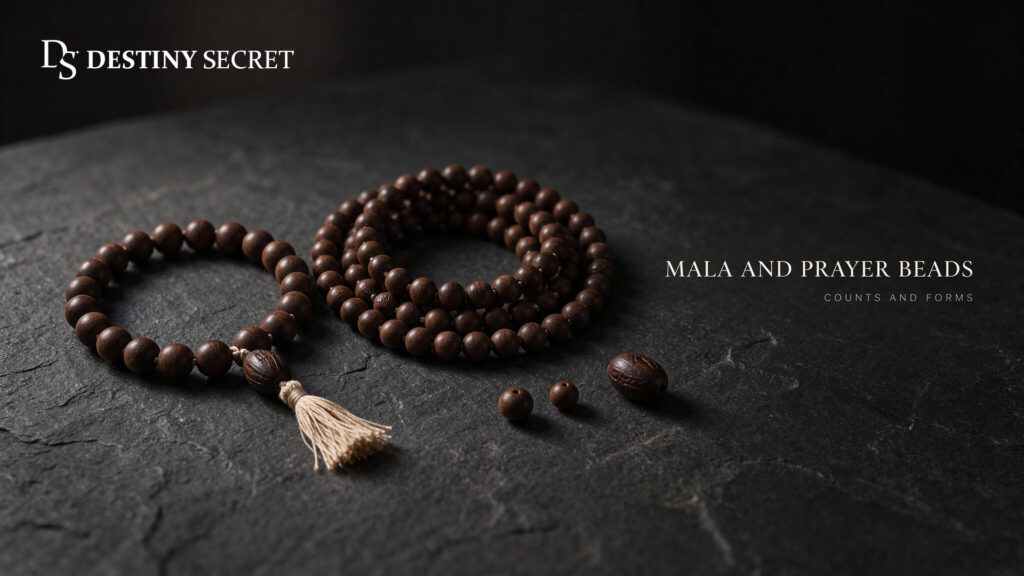
Table Of Contents
- What a Mala Actually Is
- The Counts, and Where They Come From
- Wrist Malas and the 27-Bead Form
- Materials, and What They Signal
- Why the Guru Bead Is Larger
- Wearing One Without the Practice
- Prayer Beads in Other Traditions
- Knots, Spacing and Hand Feel
- Sizing and Wrapping a 108
- Care for Wood, Seed and Stone
- Adding a Charm Without Breaking the Logic
- Frequently Asked Questions
What a Mala Actually Is
A mala is a strand of counting beads used in Hindu and Buddhist practice, and a mala beads bracelet is the wrist-sized version of the same object. The full form has 108 beads plus one larger guru bead.
No number here is arbitrary, because it matches fixed repetitions in several traditions. It corresponds to a fixed number of repetitions in several traditions, and the guru bead marks the finish rather than counting as a bead.
On a mala beads bracelet the tassel hangs from the guru bead. In traditional use it keeps the strand oriented, so the hand knows where to stop without looking.
The Counts, and Where They Come From
| Form | Bead count | Marker | Usual wrist fit |
|---|---|---|---|
| Full mala | 108 | Guru bead and tassel | Wraps three to four times |
| Wrist mala | 27 or 21 | Guru bead | Single loop |
| Tasbih | 33 or 99 | Imam bead | Single loop at 33 |
| Rosary | 59 | Cross and medal | Wraps twice at most |
A 108-bead strand does not fit a wrist in one loop. It is worn wrapped, and the wrap count depends on bead size rather than on the wearer’s preference.
Bead counts against wrist size are worked through in How Many Beads per Bracelet, and the same arithmetic applies here.
Wrist Malas and the 27-Bead Form
A 27-bead mala is a quarter of the full count, and it is the version most often sold as a bracelet. It loops once around an average wrist.
A 21-bead mala beads bracelet is shorter and reads as a bracelet first. They suit a small wrist and lose some of the counting function, since 21 is not a quarter of 108.
Both keep the guru bead, which is what a mala beads bracelet shares with the full form. That single larger bead is what distinguishes a mala from a strand of round beads with a tassel attached.
Materials, and What They Signal
Sandalwood and rosewood are the traditional woods. These woods also carry scent, warm against the skin and darken with handling.
Bodhi seed and lotus seed are used in Buddhist strands. They are lighter than wood and show a natural grain that no dye imitates well.
Stone versions of a mala beads bracelet use jade, onyx, labradorite or quartz. They are heavier, permanent and indifferent to water, which suits daily wear better than seed does.
Why the Guru Bead Is Larger
The guru bead stops the hand, then marks the end of a cycle. Counting fingers travel bead by bead and need a physical signal at the end of the cycle.
Its size is functional before it is decorative. A guru bead the same size as the rest makes the strand hard to use and easy to miscount.
It also carries the tassel, which is the second orientation cue. Remove both and the object becomes a bracelet with no counting logic.
Wearing One Without the Practice
Plenty of people wear a mala beads bracelet because they like the look. That is a common and unremarkable choice, and no tradition requires otherwise.
What changes, however, is the reading. A strand with 108 beads and a tassel is recognised as a practice object, and wearing it as fashion is a visible borrowing.
Treating a mala beads bracelet with some care is the simple courtesy. The symbol carries meaning for others even when it carries none for the wearer.
Prayer Beads in Other Traditions
A tasbih uses 33 or 99 beads and a long imam bead rather than a tassel. The shape is usually a shorter, denser strand.
A rosary bracelet uses decade groups of ten with a medal between them. The grouping is visible in the spacing, which is what makes it recognisable.
Both are counting tools with the same logic as a mala. Differences sit in count, marker and how the strand is held. Style families beyond the practice forms are collected in Beaded Bracelet Styles.
Knots, Spacing and Hand Feel
Traditional malas are knotted between beads, while cheaper versions are not. The knot holds spacing and stops beads from sliding into a cluster.
Knotted strands feel firmer and click softly when moved. Unknotted ones are softer and cheaper to make, and they drift out of even spacing.
Spacing also protects the count. Beads that slide together make a cycle hard to follow by touch alone.
Sizing and Wrapping a 108
In practice, three wraps on an average wrist need roughly 54 to 60 cm of strand, which a 108-bead mala at 8 mm provides.
Four wraps need 70 cm or more, and the strand starts to look crowded above the wrist bone.
Wrap tension matters more than length. A mala worn tight cannot be counted without stopping, and a loose one slides down the forearm.
Care for Wood, Seed and Stone
Wood and seed dislike water, therefore a stone version is easier to live with. Soaking swells the grain, and repeated soaking splits it along the length.
Stone versions tolerate a rinse and a dry cloth. No oil, since oil darkens wood unevenly and leaves stone greasy.
Restringing a knotted mala takes patience, and the technique is the same one used on any bead strand. The parts that carry the tension are named in What Are Beaded Bracelets.
Adding a Charm Without Breaking the Logic
A charm on a mala goes beside the guru bead, never mid-count. Placed in the middle it interrupts a cycle that the hand is tracking.
The same rule governs other symbolic beads. An eye bead belongs where the pattern stays visible, which is the subject of Evil Eye Bead Meaning and Styles.
Two accents on one strand is the ceiling. Beyond that the strand stops reading as a practice object and starts reading as a souvenir, a point Charm and Pendant Beads takes further.
Frequently Asked Questions
Does a mala beads bracelet have to hold 108 beads?
No. A wrist mala at 27 beads is a standard quarter count, and 21-bead versions are common. The full 108 is worn wrapped rather than looped.
Can anyone wear mala beads?
Yes. Wearing one without a practice is common, though the strand will still be read as a practice object by people who use them.
Should mala beads be knotted?
Traditionally, yes. Knots hold the spacing and keep the count readable by touch, and they make the strand feel firmer on the wrist.
Can I shower in a wooden mala?
Better not. Wood and seed swell with water and split over repeated soaking, while stone versions tolerate a rinse.
Every Destiny Secret strand is handcrafted and unique, and where a strand follows a counting tradition the marker bead and spacing are kept as the tradition intends.