
Jade earrings fail for one reason more than any other: the stone is heavy and the earlobe is not.
Style therefore comes second to weight, length and setting, and a pair that ignores those three pulls, twists and eventually stretches the piercing.
Four structures cover the market, and each carries a different load.
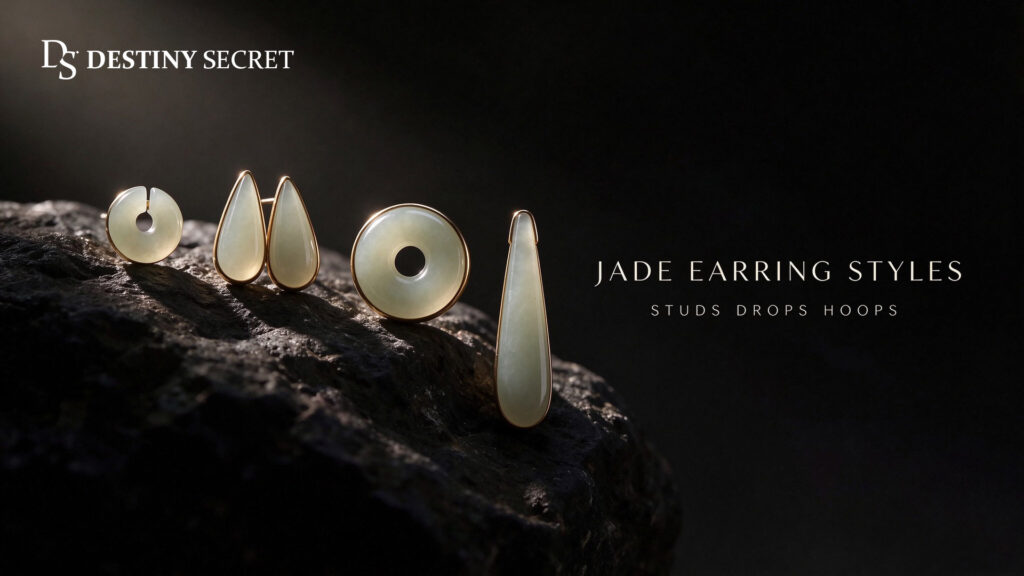
Table of Contents
- Why Earrings Are the Hardest Jade Form
- The Four Structures
- Studs and Coverage
- Drops and Length
- Hoops and Half Hoops
- Why Chandeliers Fail in Jade
- The Setting Protects the Stone
- Ear Wires and Backings
- Weight Limits
- Length and Face
- What to Check Before Buying
- Care and Wear Over Time
- Frequently Asked Questions
Why Earrings Are the Hardest Jade Form
A bangle sits on a wrist that supports it, and a pendant hangs from a chain built for the load.
An earring hangs from a few millimetres of soft tissue, and jade weighs roughly 2.9 grams per cubic centimetre.
That density is why a jade disc the width of a fingertip already outweighs a comparable silver piece.
Jadeite and nephrite both sit in that range, and What Is Jade distinguishes the two minerals.
The stone also has no give, so any knock travels straight into the setting and the lobe.
Everything below follows from those two facts.
Weight ranges for the wrist forms sit in Jade Bracelet vs Bangle.
The Four Structures
Jade earrings divide by how the stone attaches to the ear rather than by ornament.
| Structure | Typical length | Typical stone weight | Load on the lobe |
|---|---|---|---|
| Stud | Under 12 mm | 1 to 3 g | Light |
| Drop | 20 to 40 mm | 3 to 6 g | Moderate |
| Hoop | 15 to 30 mm | 2 to 5 g | Moderate, balanced |
| Chandelier | 50 mm and up | 8 g and up | Heavy |
The table is a starting point rather than a rule, since a dense stone and a thin setting shift every figure.
Studs and Coverage
A stud is the safest jade earring and the least expressive, which is why it sells first and photographs worst.
Diameter decides coverage: 6 mm reads as a dot, 10 mm covers the lobe, and 14 mm becomes a statement on most ears.
Above 14 mm the stone starts to pull forward, because the centre of mass sits ahead of the piercing.
Past that point the earring also reads as a disc rather than a stone, and the lobe disappears behind it.
A domed stud hides weight behind the lobe and balances better than a flat disc of the same diameter.
Studs suit daily wear, sleeping and travel, and they are the only style that survives being worn under a headset.
A pair at 8 mm covers most of the lobe and still weighs under two grams, which is why it outsells every other jade earring.
Drops and Length
Drops add movement, and movement multiplies the effective load.
A 25 mm drop swings with a lever arm roughly twice that of a 12 mm stud, so the same stone weight pulls harder.
Jade drops usually use a teardrop, a gourd or a carved leaf, and the carving thins the stone at the edges where knocks land.
Under 30 mm the drop stays clear of a collar and works with most necklines.
Over 40 mm the earring starts to compete with a necklace, and the two should not be worn at the same visual weight.
Necklace lengths that pair well with a long drop sit in Jade Necklace Lengths.
Hoops and Half Hoops
A jade hoop is usually a thin ring, a disc with a hole, or a half hoop that hugs the lobe.
The full hoop distributes weight evenly around the ear and therefore feels lighter than its gram weight suggests.
A bi disc, meaning a flat ring with a central hole, is the classic version and reads as a graphic circle rather than a stone.
Half hoops and ear climbers put the stone beside the lobe rather than below it, which removes almost all swing.
That makes climbers the best option for anyone whose lobe has already stretched.
Why Chandeliers Fail in Jade
A chandelier earring depends on many small light elements hanging in tiers.
Jade cannot supply that: each tier needs its own stone, and three tiers of jade reach eight grams before the metal is counted.
The result swings, catches hair and pulls the piercing forward within an hour.
Jade chandeliers exist and sell, and most of them are worn once.
A single long drop with one carved tier reads as elaborate without the load.
Carving thins the stone exactly where an earring takes its knocks, and the sequence that produces those shapes sits in Jade Carving.
The Setting Protects the Stone
Setting matters more for jade than for a faceted gem, because jade fails at its edges.
A bezel, meaning a metal rim around the whole stone, shields every edge and is the strongest option.
Prongs leave most of the stone exposed, which shows more jade and leaves the rim open to knocks.
Four prongs on a small disc hold the stone at four points and leave the rest of the rim unsupported.
For carved pieces the bezel should follow the outline, and a partial bezel leaves the carved points unprotected.
Half-drilled settings that rely on a pin through the stone are the weakest, since the drill hole is a built-in crack.
Gold settings change the visual weight as well as the protection, and Jade and Gold covers the pairing.
Ear Wires and Backings
Three fittings dominate, and each suits a different weight.
| Fitting | Best for | Limitation |
|---|---|---|
| Post with butterfly back | Studs under 4 g | Back slips on heavy stones |
| Lever back | Drops and hoops | Needs a longer post than a stud |
| Hook or French wire | Light drops | No lock, so it swings free |
A post of 0.8 mm, which is the common 20 gauge, suits most lobes.
Heavier stones need 1 mm or thicker, since a thin post bends under load and the earring drifts downward.
Any metal against the piercing should be nickel-free, and surgical steel or 18K gold are the usual safe choices.
Weight Limits
An earlobe tolerates more weight than intuition suggests, and it pays for that tolerance over years.
Under 3 grams a pair feels weightless and can be worn continuously.
Between 3 and 6 grams the earring is noticeable by evening, and the lobe begins to look longer.
Above 10 grams the piercing stretches visibly within months of daily wear.
Stretched lobes do not recover on their own, and a lobe that has lengthened makes every future earring sit lower.
Weigh the pair, not the single earring, when comparing options.
Length and Face
Length changes proportion more than any other variable.
Short studs widen a narrow face and keep attention at eye level.
Drops between 20 and 30 mm lengthen a round or square face without pulling it down.
Long drops past 45 mm draw the eye to the jaw and neck, which suits a long neck and a high collar.
A very long drop on a short neck closes the space between earlobe and shoulder and reads crowded.
The mirror test is simple: if the earring ends within 2 cm of the collarbone, it is competing with the neckline.
Men wear the same styles at larger scale, usually a 10 mm stud or a straight drop, and Jade Styles for Men sets out those proportions.
Proportion beats decoration here: a heavy stone on a small face looks borrowed rather than chosen.
What to Check Before Buying
Five checks settle most of the risk.
- Pair weight in grams, both earrings together.
- Total drop length, measured from the piercing to the lowest point.
- Setting type, with a full bezel preferred for carved stone.
- Post thickness of at least 0.8 mm, and the metal stated as nickel-free.
- Backing type matched to the weight.
Our Jade Earrings list pair weight, drop length and post gauge for every style, so the three figures can be compared side by side.
Ask for the weight rather than trusting a photograph, since jade reads lighter on screen than in the hand.
A pair that arrives heavier than stated should go back inside the return window.
Care and Wear Over Time
Jade earrings take knocks that bangles never see: hair, scarves, headphones and seatbelts.
Take them off before sleeping, since a stone pressed against a pillow for eight hours stresses the setting.
Store each pair separately in a soft pouch, because jade scratches jade.
Wipe the stone with a soft cloth after wear, and keep perfume and hair products off the surface.
Remove earrings before sport, and check the bezel for looseness twice a year.
Cleaning routines, storage and the seasonal checks that keep a stone pair wearable sit in Jade Care.
Frequently Asked Questions
Are jade earrings too heavy to wear?
Not if the pair stays under 3 grams for daily wear and under 6 grams for evening. Above 10 grams daily, the piercing stretches within months.
What is the best jade earring style for daily wear?
A stud or a half hoop. Both keep the stone close to the lobe, so there is almost no swing and the load stays light.
Should jade earrings have a bezel or prongs?
A full bezel. Jade fails at its edges, and a rim around the stone shields every edge from knocks.
How long should jade drop earrings be?
Between 20 and 30 mm for most faces. Past 45 mm the earring competes with the neckline and needs a long neck to carry it.
Weight and comfort figures are general guidance for pierced lobes. Individual anatomy, settings and stones vary, and pierced ears with a history of stretching should be assessed in person.
Browse the full Jade Collection at Destiny Secret.